# Particle Network Overview
Powering Chain Abstraction Through Universal Accounts
## Particle Network
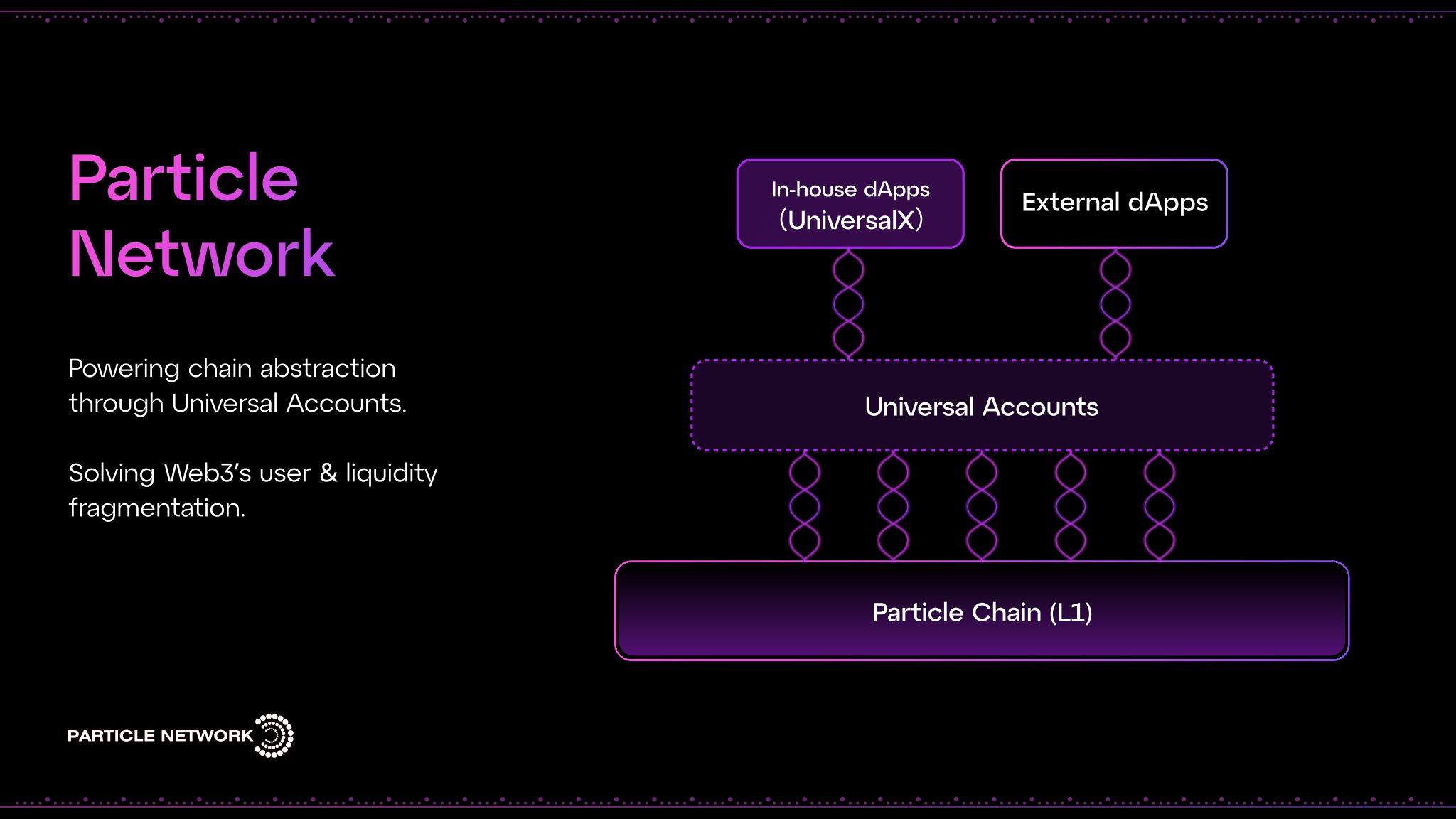
Particle Network is the Layer-1 blockchain powering chain abstraction, seamlessly unifying users and liquidity across Web3. At its core are Universal Accounts, which provide users with a single account and unified balance across all chains. These accounts are coordinated and secured by Particle Network, ensuring a frictionless experience across the entire Web3 ecosystem.
By unifying all chains, Particle will enable billions of users to seamlessly onboard and interact with dApps across every chain, serving as the foundation for mass adoption and playing an indispensable role in unifying the Open Web.
Eventually, the $PARTI token will power the economy of Particle Network and its underlying infrastructure.
## A Thriving Ecosystem
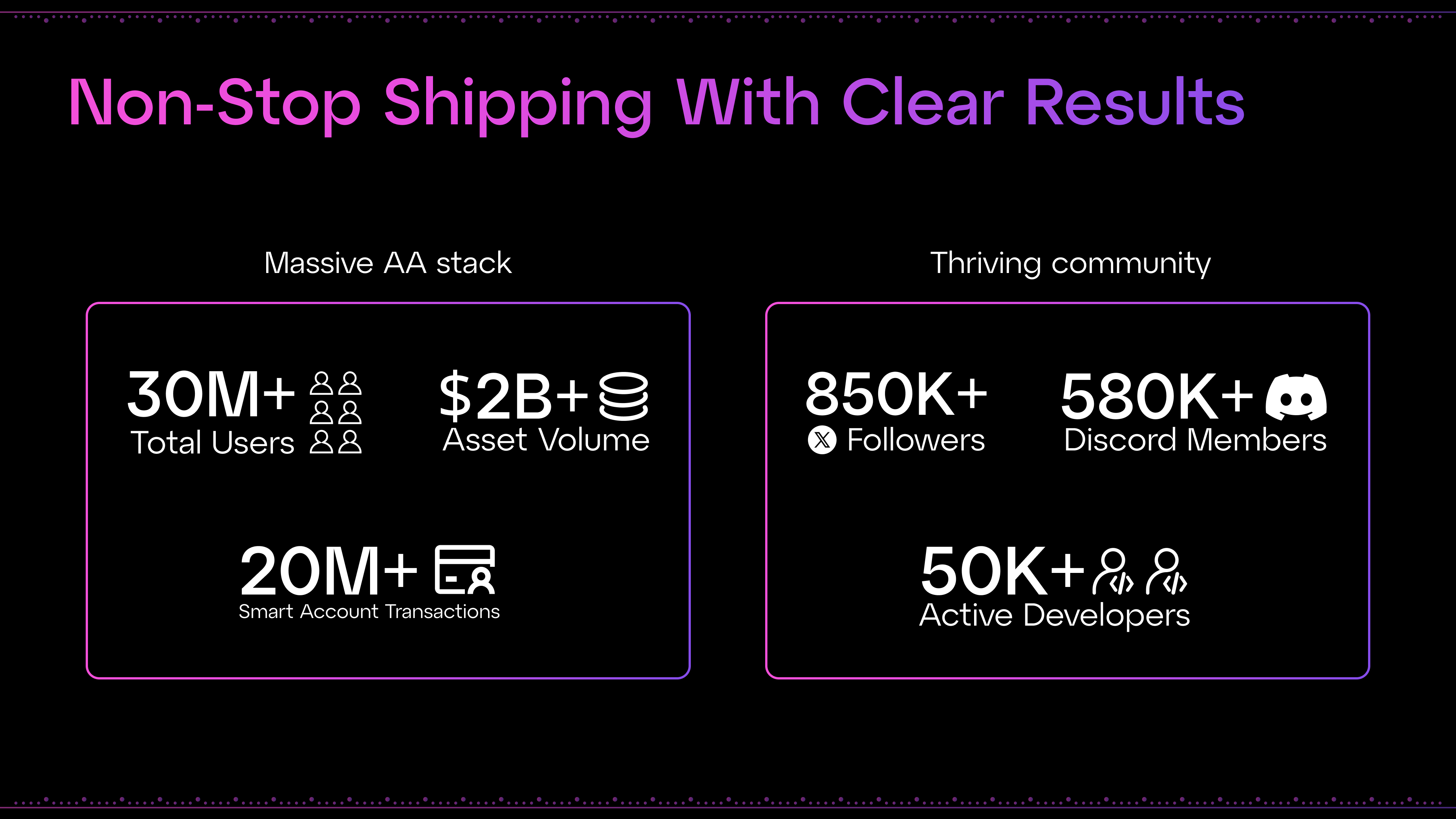
Launched in 2022, Particle Network debuted as a Wallet Abstraction service provider, enabling users to create wallets linked to their Web2 social accounts, which can then be used natively within dApp-embedded interfaces. This product offering then expanded into Account Abstraction, where Particle Network became Web3's largest provider of AA infrastructure, offering services across 70+ chains, with \~20M cumulative UserOps and securing $2B+.
Particle's solutions also span the Bitcoin ecosystem through BTC Connect, used by all major BTC Layer-2 blockchains. BTC Connect enables native BTC wallets to act as Signers for Particle AA Wallets on BTC L2s. This allows users to use only native Bitcoin wallets (like UniSat) to sign and authorize transactions on Smart Accounts without relying on additional products.
After over 30 million wallet activations and over 7,000 dApp integrations later, Particle Network is taking the next step in its evolution by debuting Universal Accounts to power chain abstraction, taking Web3 to the next level in UX terms.
Furthermore, Particle has also built the first chain-agnostic Mainnet application leveraging Universal Accounts: [UniversalX](/particle-network/abstraction-functionalities/universalx).
# Why Particle Network
Solving user and liquidity fragmentation through Universal Accounts.
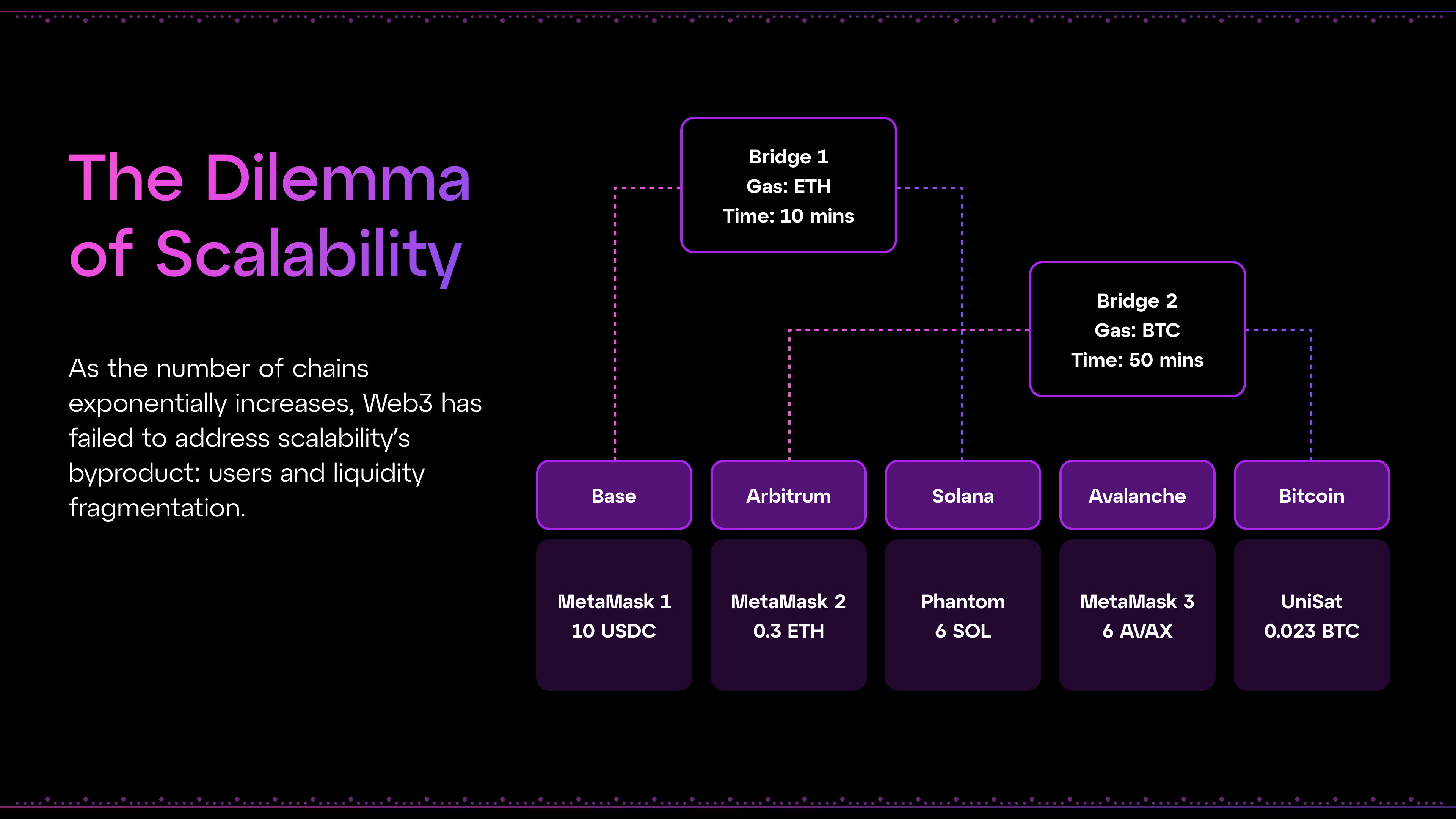
With the blockchain ecosystem transitioning from a monolithic to a modular paradigm, we have witnessed the explosive growth of composable, application-specific blockchains, yielding thousands of new ecosystems.
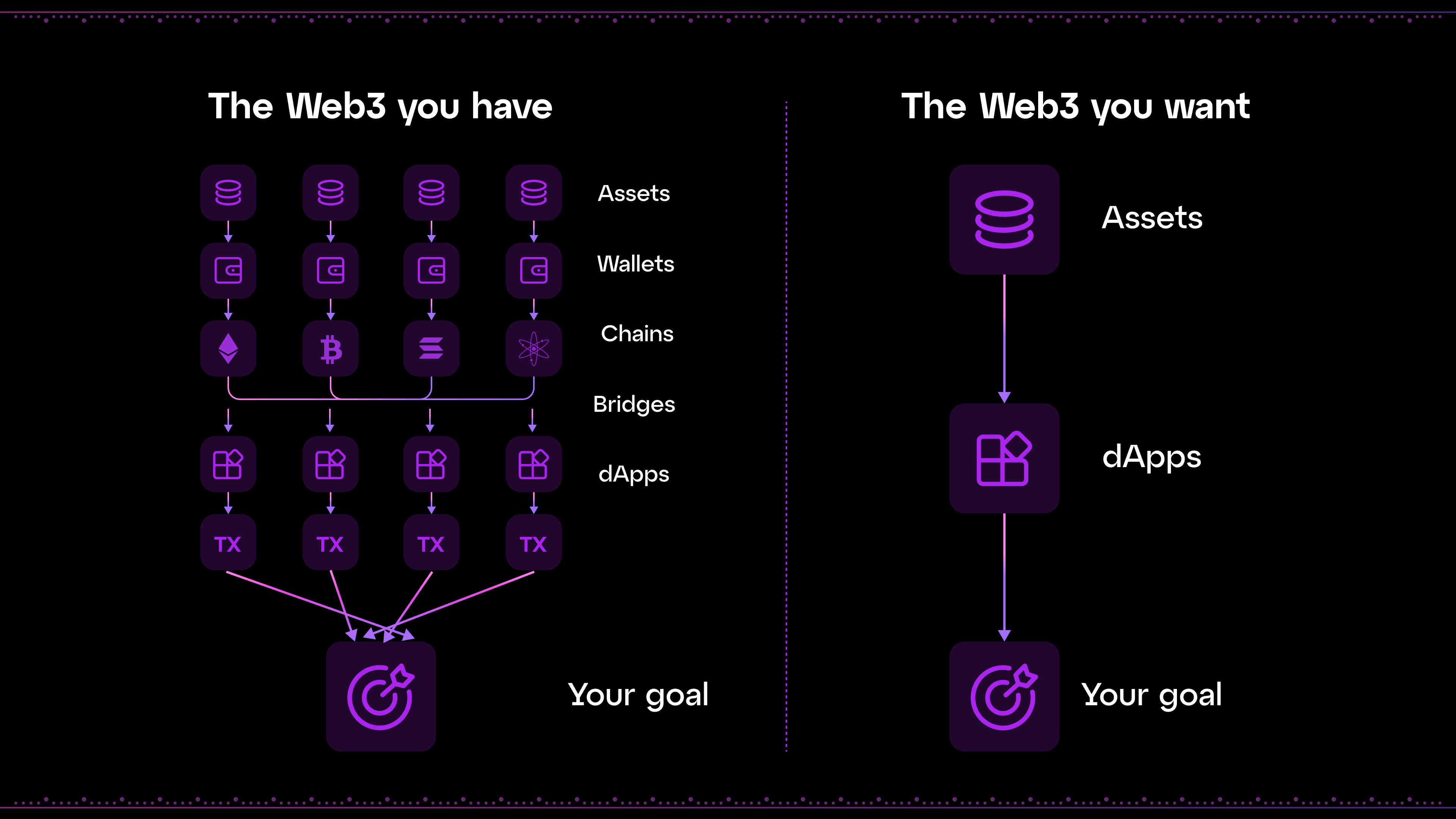
Modularity enables high-performance, scalable, and customizable blockchain architecture, but at the cost of the self-containment and efficiency of monolithic blockchains. It can be observed that, in a modular multi-chain ecosystem, while the problem of limited block space and flexibility is eliminated, user experience is complex, liquidity is fragmented even further, and the cost of interacting across multiple chains remains high.
For developers, fragmentation results in a separate set of challenges, as user dispersion across multiple chains, high costs, and the cumbersome process of transitioning from chain to chain force them to forego users from specific ecosystems, significantly limiting the growth of their applications.
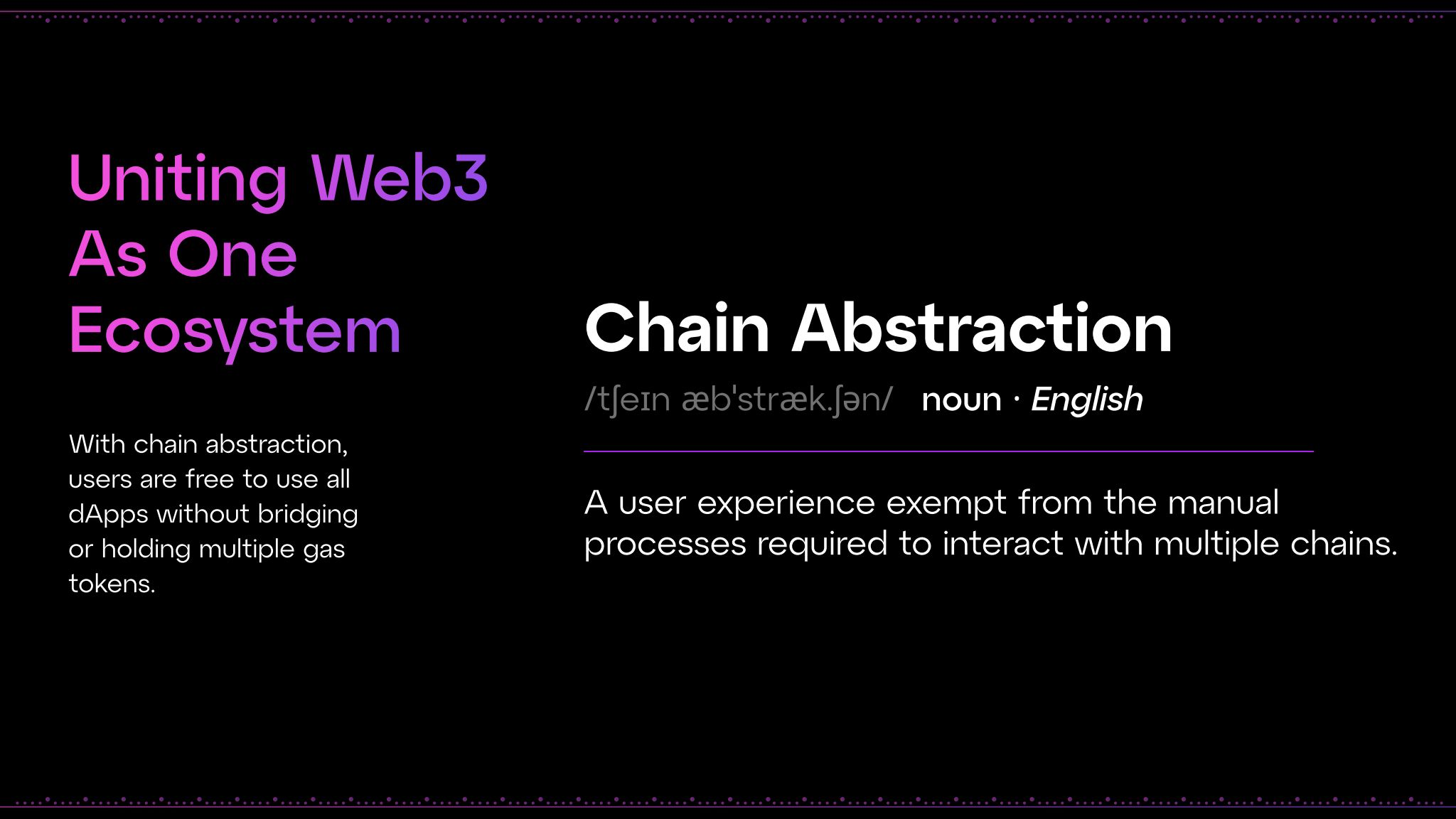
To tackle these problems, Particle Network has devised a unique strategy to enable chain abstraction through Universal Accounts (powered by the Particle Chain), understanding chain abstraction as the missing piece in the transition between Web3's early and mainstream stages.
\
Chain abstraction allows Web3's product offering and network effects to radically increase in both quantity and quality. This can foster healthy competition among protocols in terms of products, not user bases. Furthermore, in a chain-abstracted paradigm, protocols can adopt application-specific blockchains at a higher rate without fear of isolating themselves from the rest of the ecosystem.
\
A fully chain-abstracted experience may look as follows:
* Alice discovers a Play-to-Earn dApp. The dApp is hosted on Arbitrum.
* Alice starts using the dApp. The assets in her wallet (Polygon-native) are used for basic dApp interactions. Bridging is automatic, executed atomically as she plays.
* After playing for a bit, Alice earns some tokens. She uses them to buy an NFT for her friend Bob's birthday. Unbeknownst to her, the NFT is hosted on Optimism. She can seamlessly send it to Bob's Universal Account. Importantly, throughout her whole experience, Alice has only used a single gas token.
* Bob decides to take a loan against the NFT on Solana and use the proceeds to buy a meme Bitcoin Ordinal. He does this in just a few clicks within a few minutes, all through the same account.
Particle Network proposes a system that achieves chain abstraction by acting as a universal settlement layer. It features a Universal Account protocol that synchronizes Smart Accounts across the ecosystem, unifying the UX across all chains and allowing users to have the same account address and balance on all of them. Universal Accounts leverage Particle's Universal Liquidity protocol, allowing users to access any chain with a single account via the automatic execution of cross-chain transactions and swaps. This shared liquidity, in turn, enables them to use any token to pay for gas, ultimately settling on the Particle Chain.
To accelerate chain abstraction, Particle Network is also collaborating closely with other industry players focused on this goal, seeking to establish standards and build upon existing solutions moving in the same direction.
# Universal Accounts
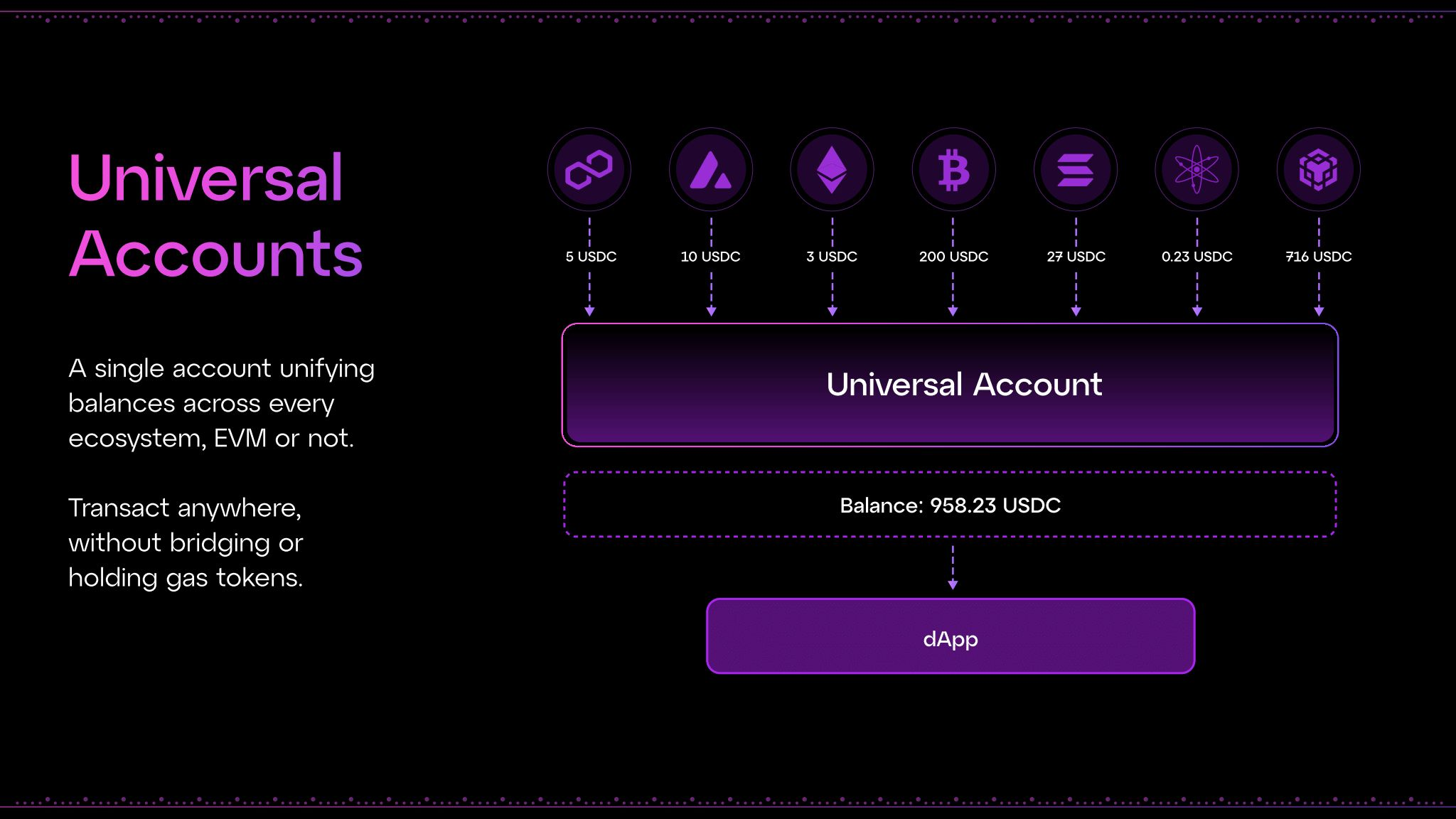
Particle Network's flagship product, Universal Accounts, enable true chain abstraction by providing users with a single address, balance, and interaction point for the multi-chain Web3 ecosystem. **This removes the need for manual bridging or multi-chain wallet/asset management.**
Users leveraging a Universal Account **maintain one balance and account state across every blockchain.** This presents a unified UX, agnostic to any specific blockchain.
On a technical level, Universal Accounts are specialized ERC-4337 Smart Account implementations deployed and coordinated across chains by the Particle Chain.
Protocols implementing Particle's Universal SDK will assign or resolve a Universal Account attached to a given EOA address, retrieved either via social logins with Particle Network's Modular Smart Wallet-as-a-Service or by connecting a typical Web3 wallet. This account will then be used as the core interface to interact with the dApp, as well as any other application leveraging Universal Accounts.
## Universal Liquidity
Particle Network's Universal Liquidity technology is the foundation of Universal Accounts. It coordinates cross-chain transactions atomically on a per-transaction basis, unifying a user's balance.
Universal Liquidity refers to the aggregation of balances across all chains. It is directly driven by atomic cross-chain transactions and swaps coordinated by the Particle Chain. Particle's Decentralized Messaging Network is used to optimistically execute multi-chain transactions on a per-interaction basis, atomically routing liquidity across chains to achieve a goal specified through Particle Network's Universal SDK.
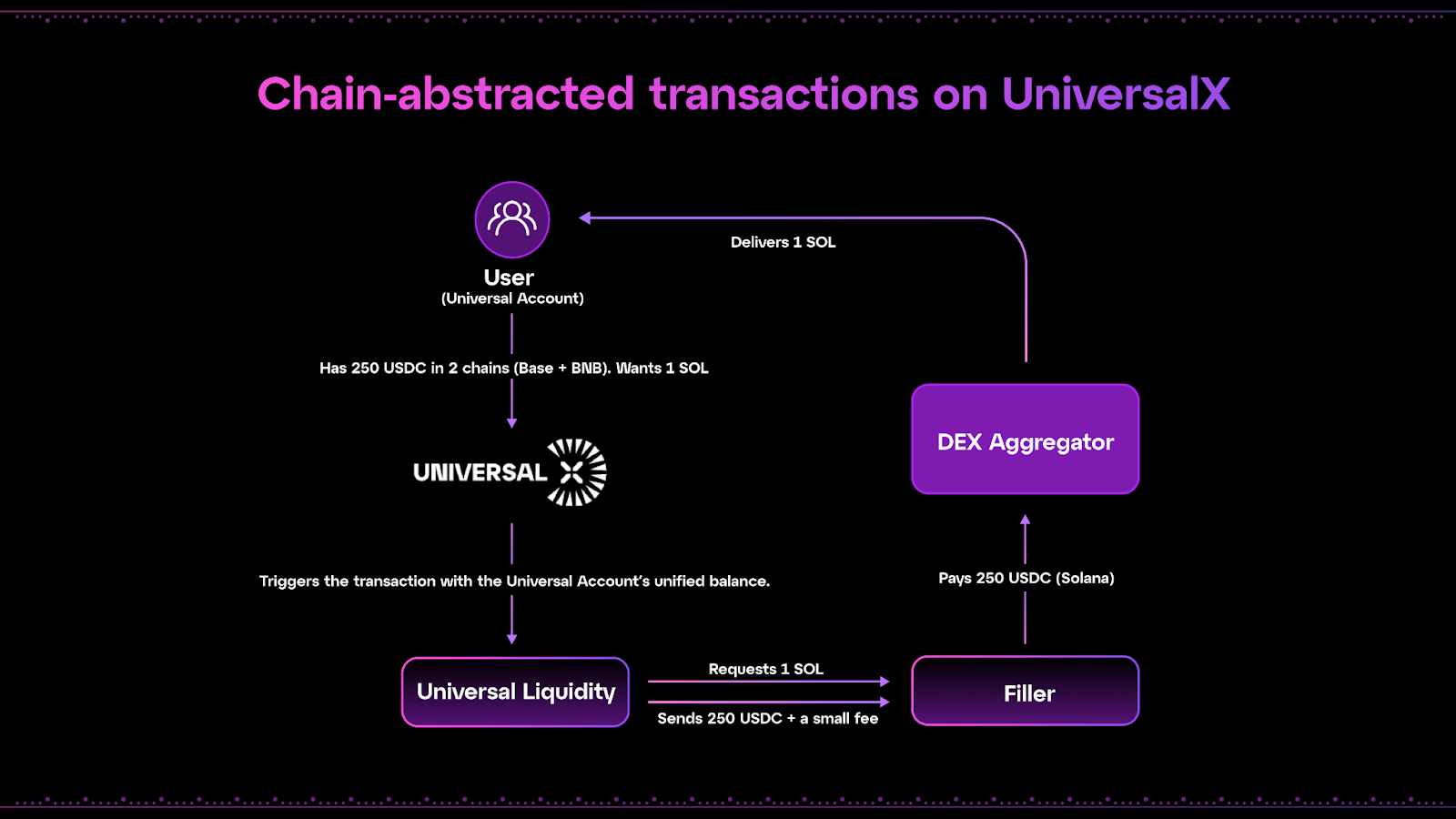
For example, if a given user has 1 ETH worth of MATIC on Polygon, but is executing a transaction requiring 1 ETH on Optimism, Particle Network will route and execute a cross-chain transaction through the initial signature provided for their intended interaction. This allows value to quickly be moved from Polygon to Optimism and used for the action in question, creating the user experience of a singular balance spanning all blockchains.
## Universal Gas
Given the unification of balances across chains through Universal Liquidity, Particle Network also solves the fragmentation of expected gas tokens, providing a cohesive experience.
Historically, maintaining gas fee balances across chains has been a significant friction point for users. Particle Network, through the usage of its native Paymaster, allows users to pay for gas fees using any token, regardless of the chain from which this token originates. This makes interactions easier, reducing the number of assets users need to execute transactions across the ecosystem. All transactions will ultimately settle on the Particle Chain through $PARTI.
# UniversalX
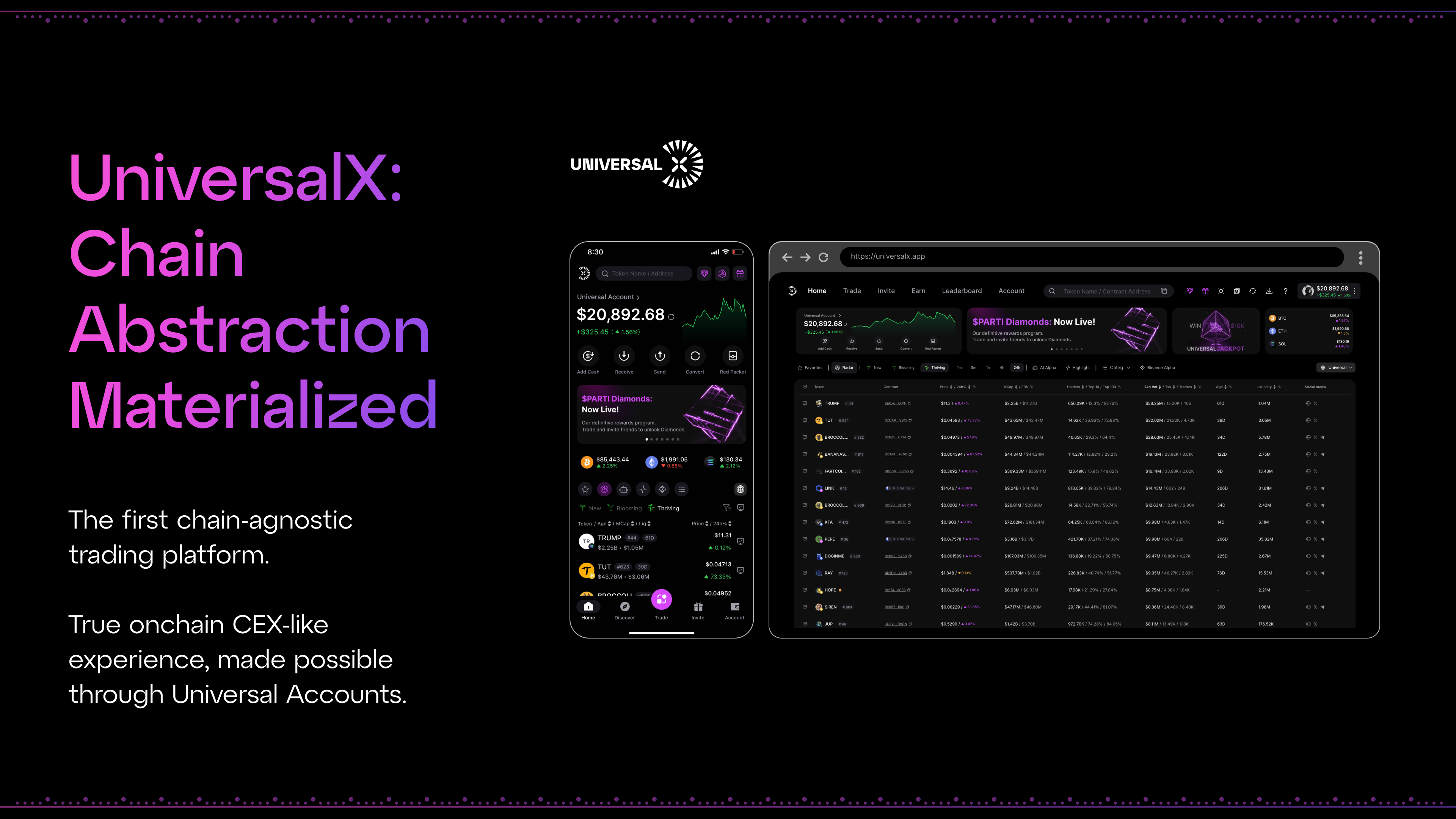
**Built by Particle Network,** **UniversalX is the first chain-agnostic trading platform, as well as the first application leveraging Particle's Mainnet, through Universal Accounts. It’s 100% non-custodial and allows users to trade any token on any chain, without bridging.**
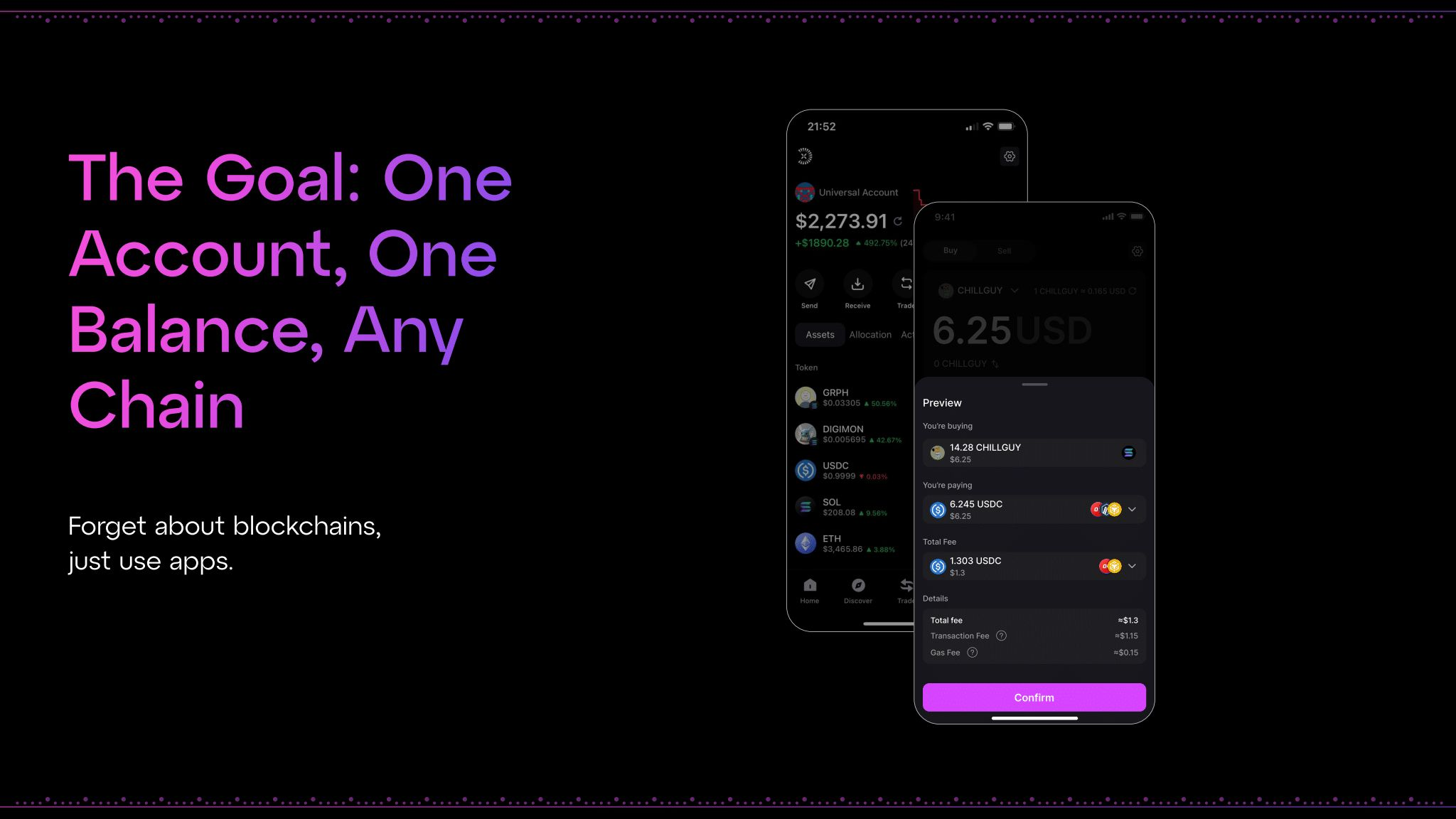
With UniversalX, users can trade, send, and receive assets using a unified balance for all chains, paying for gas with any token. In other words, if a user wants to buy a token, it doesn’t matter if their assets are spread across many chains or what chain their target token is at—they hit **Buy** and UniversalX takes care of the rest.
### **Key features**
UniversalX can be used for its chain abstraction properties or built-in trading features. It allows users to:
* Deposit tokens from different supported EVM chains and Solana.
* Use their tokens to trade on all these chains with a unified balance.
* View price, onchain, and qualitative data for any token with zero latency.
* Send assets directly to and from any chain.
* Pay for gas with any token on any chain.
* Purchase thousands of tokens, even memecoins, using cash via debit or credit card, Apple Pay, and other integrations.
* Trade with blazing-fast speed and confirmation times.
* Enjoy full MEV protection.
**All of this without bridging.**
In practice, UniversalX facilitates **a fully onchain CEX-equivalent experience.**
### Implementation of Universal Accounts
UniversalX fully leverages Universal Accounts (and, consequently, the Particle Chain) through the Universal SDK to enable a chain-abstracted trading experience.
Within the application, a user simply selects the token they want to buy. UniversalX, in turn, routes balances from every chain the user holds assets on, executing the trade in one signature and automating cross-chain operations.
# Technology
## The Particle Chain
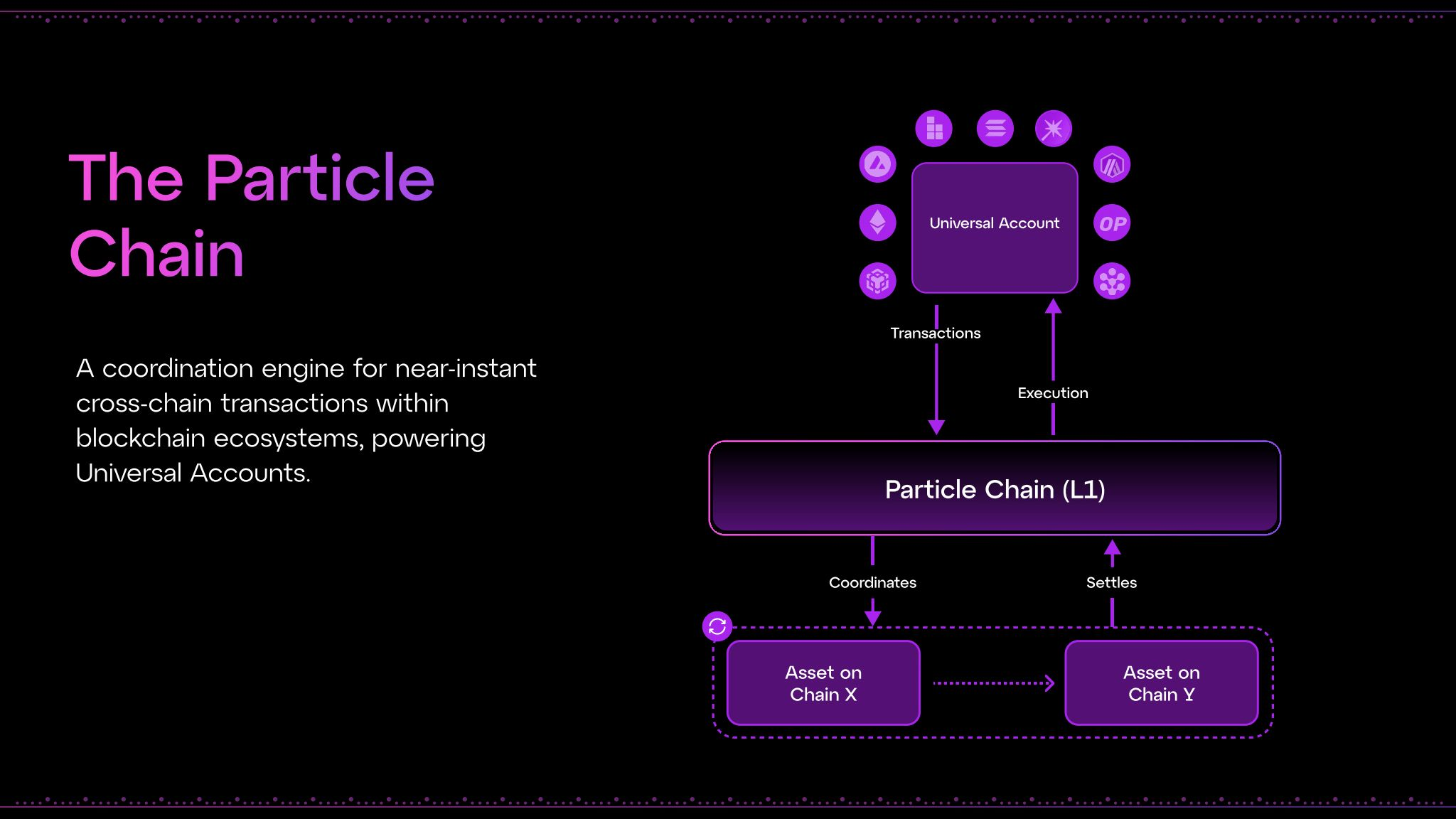
The Particle Chain powers chain abstraction by acting as the coordination engine behind Universal Accounts.
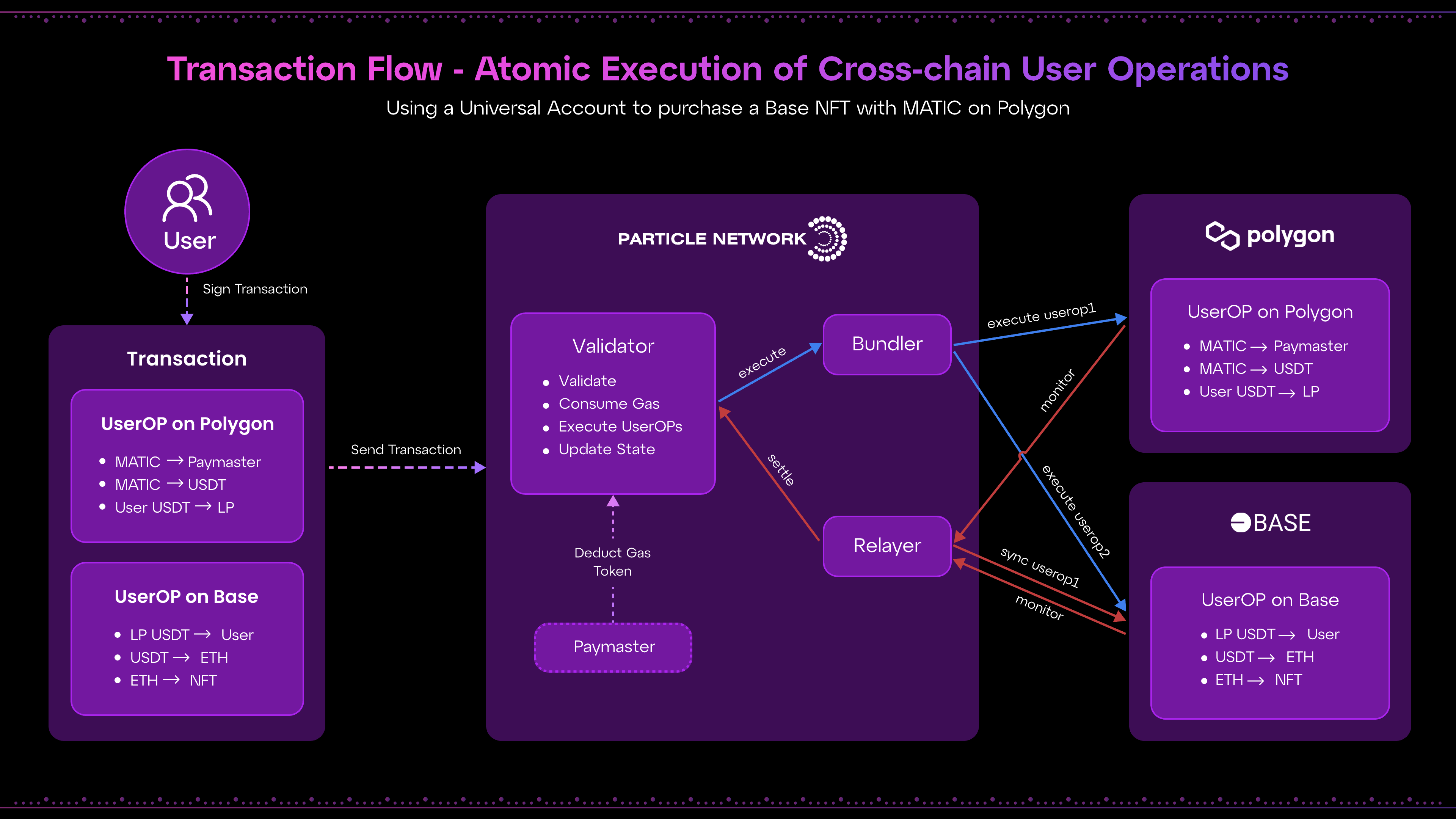
Upon the execution of a cross-chain transaction through a Universal Account, the Particle Chain processes, relays, and manages each operation associated with the completion of this transaction. Through an intricate network of Modular Nodes, including Relayers, Bundlers, and Watchtowers, alongside its native Universal Inter-Blockchain Communication Protocol, the Particle Chain handles end-to-end cross-chain operation management and execution, enabling the Universal Liquidity leveraged by Universal Accounts.
Furthermore, the Particle Chain acts as a central storage layer and source of truth for state parity across all Universal Account instances. Upon the deployment of a new Universal Account, its state is immediately synchronized with associated instances present on other chains through the usage of the L1's Master Keystore Hub.
The Particle Chain is intrinsically modular, retaining its sovereignty while outsourcing key functions like validation and data availability to specialized ecosystem actors. We also offer a high-performance EVM execution environment, ensuring seamless compatibility and maintaining developer friendliness.
# Underlying Architecture
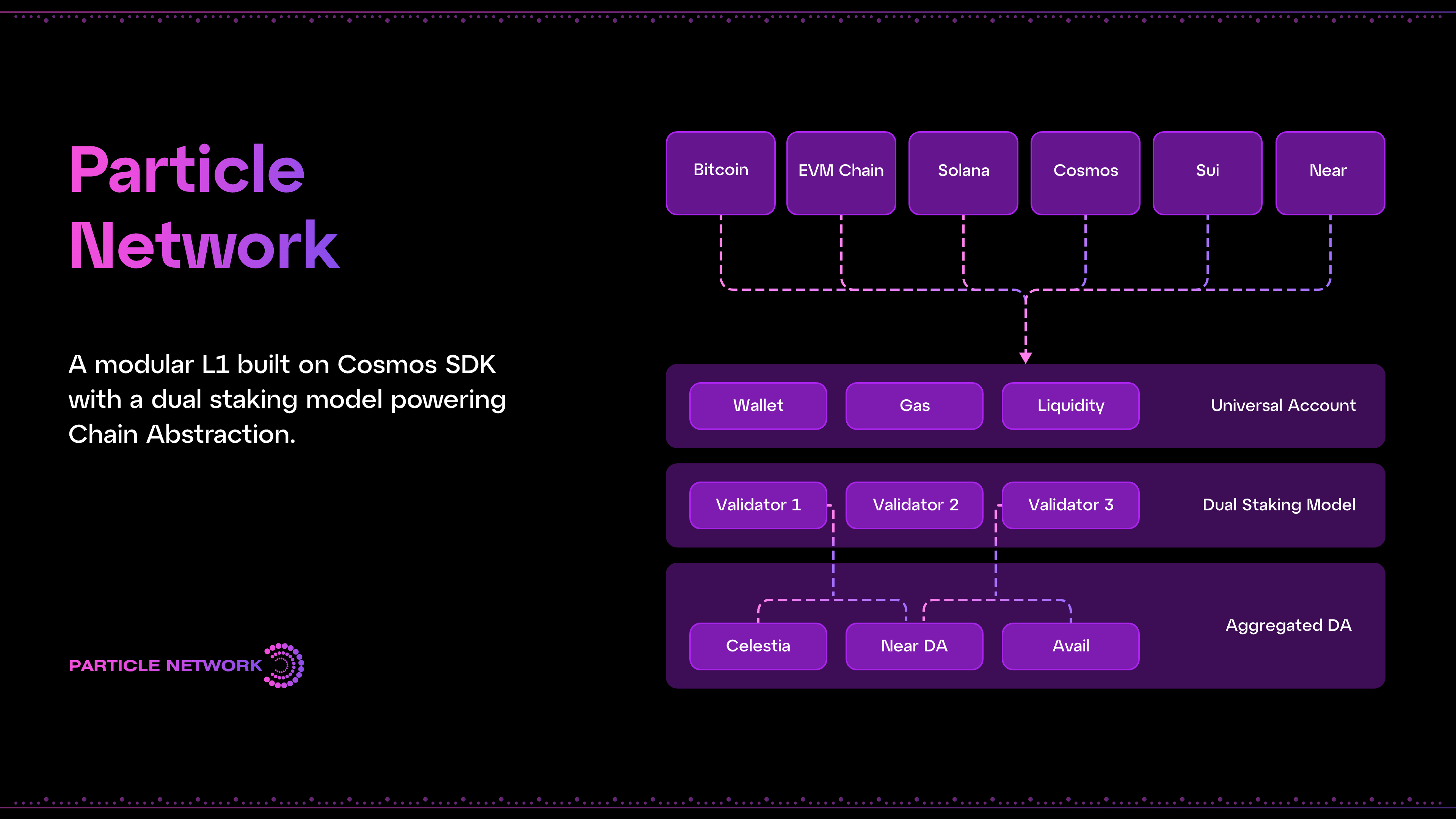
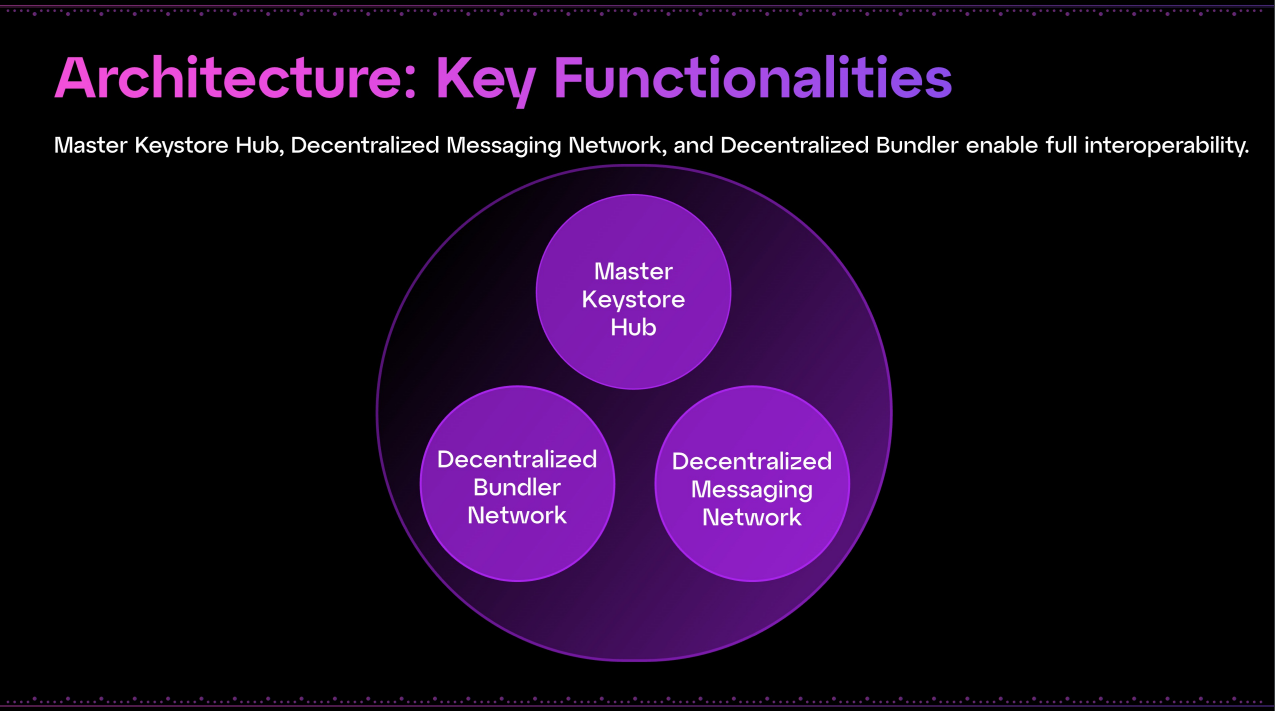
The Particle Chain is an Avalanche L1. Its architecture aims to achieve fast finality, high transaction throughput, and short block times. It relies on three core modules **(the Master Keystore Hub, Decentralized Bundler, and Decentralized Messaging Network**) to achieve chain abstraction. These, in turn, are supported by **Aggregated Data Availability** and **Dual Staking** modules to ensure network security.
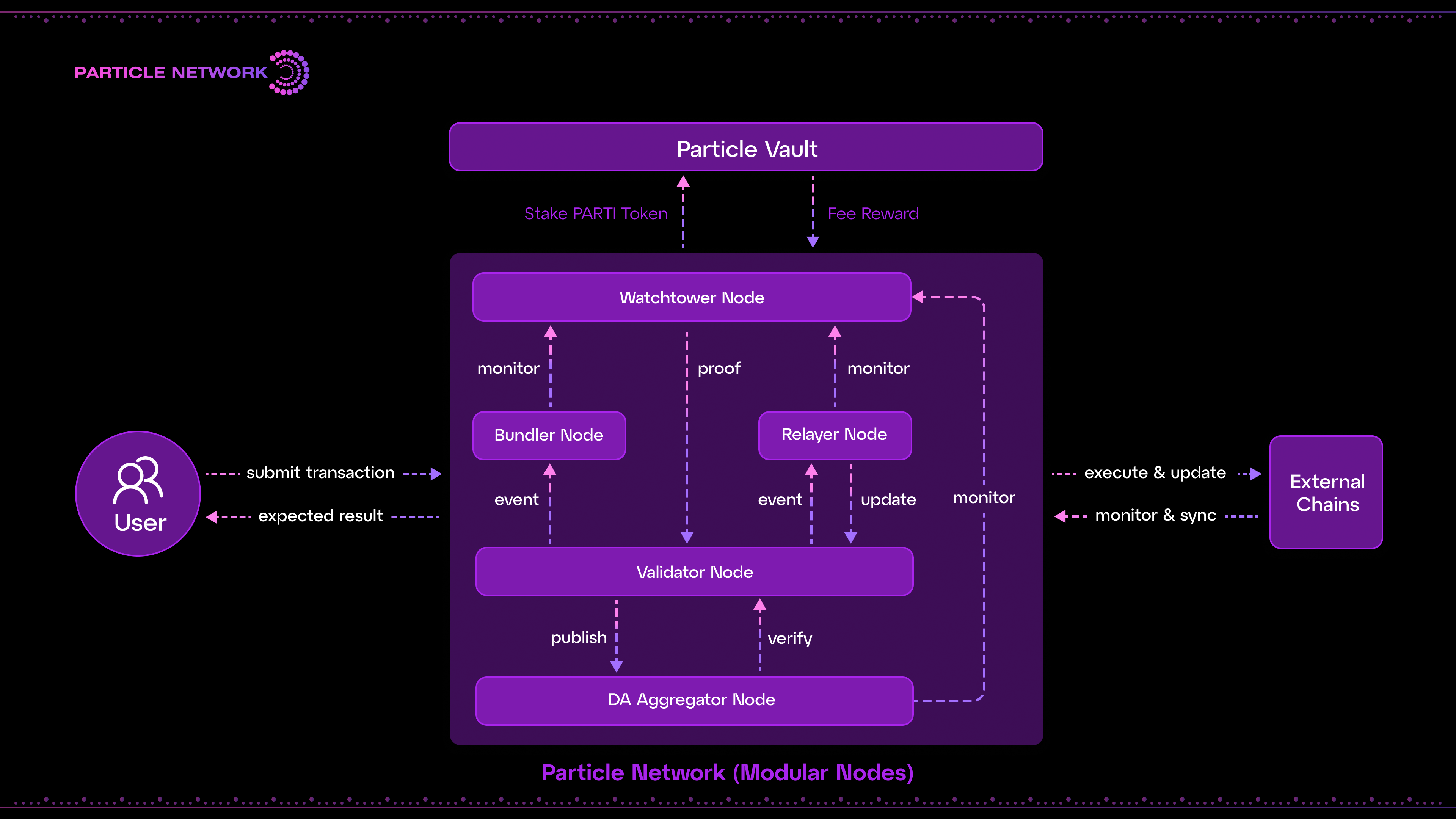
The chain's high-level architecture is diagrammed below:
Some core components that are key to this architecture are:
## VMs compatibility
By integrating the EVM, SVM, and MoveVM, we simplify full-chain interoperability with chains across all of the aforementioned VMs. The unified execution environment further reduces the ecological adaptation threshold, allowing flexible modular combinations with key areas such as cross-chain messaging and DeFi.
## Universal Signatures
Serving MPC nodes on non-Smart Contract Platform chains, Universal Signatures provides support for underlying virtual accounts, enabling interoperability with accounts on heterogeneous chains, such as Bitcoin.
## Universal IBC
Building upon existing cross-chain messaging components, we abstract an optimistic cross-chain messaging module powered by our Decentralized Messaging Network that can simultaneously connect Cosmos ecosystems, EVM chains, Solana, Bitcoin, and other chains. This component supports rapid settlement and is crucial for a transparent user experience.
# Core Modules
Within this modular L1, the following modules support the design and ongoing coordination of Universal Accounts:
* **Master Keystore Hub**: Particle Network acts as the central hub coordinating smart contract deployments and updates across all networks, automatically synchronizing settings between each Universal Account instance and ensuring complete state parity across networks. Account settings are stored on Particle Network to be used as a central source of truth across every instance. The Particle Chain then facilitates cross-chain messages to either deploy new instances abiding by these settings or update existing instances as these settings change.
* **Decentralized Messaging Network (DMN)**: On Particle Network, Relayer Nodes use a Messaging Protocol to monitor whether UserOperations on external chains have been executed successfully, and then settle the execution status on the Particle Chain. This network of decentralized Relayer Nodes, tasked with monitoring external chain events and the settlement of state events, is called the Decentralized Messaging Network.
* **Decentralized Bundler**: While current implementations of ERC-4337 account abstraction Bundlers are centralized and as such censorable, Particle Network has designed and implemented a fully decentralized Bundler for high-volume UserOperation processing. Within this implementation, the Bundler takes transactions from a public UserOp mempool, upon which they're processed by Operators participating in Particle Network's custom Bundler Nodes before relaying them.
# Dual Staking
Following a similar philosophy to AggDA, Particle Network approaches consensus by focusing on ensuring a high degree of cryptoeconomic security and accessibility.
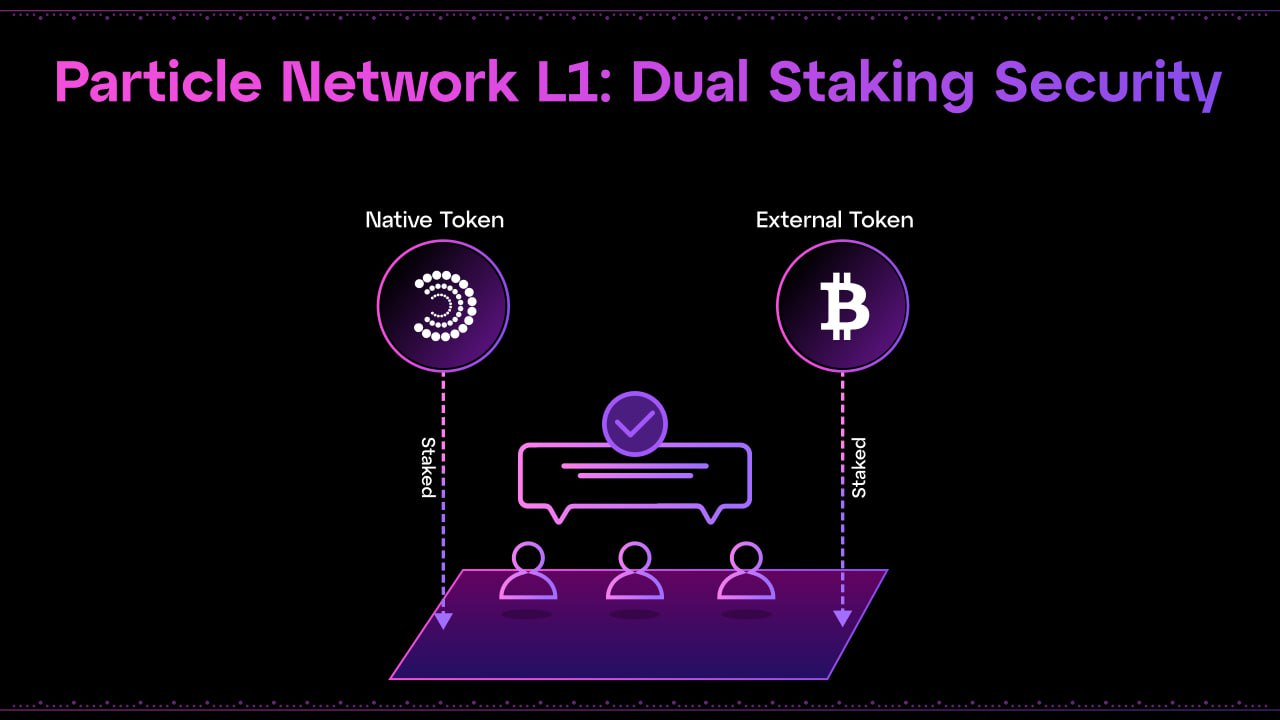
Bootstrapping a Proof-of-Stake network can be risky, often leading to undesirable volatility affecting the network's value and stability. To solve this, the Particle Chain features a dual staking system, combining Proof-of-Stake through Tendermint with Bitcoin's native security and censorship resistance. Babylon's Bitcoin staking protocol makes this.
Dual staking leverages two distinct pools of operators: one with delegations of Particle Network's native token, and another with delegations of BTC through Babylon. Both groups are required to agree on validity individually, warranting equal participation in consensus.
A model of this nature significantly reduces pressure and security dependence on Particle Network's native token, instead bootstrapping the network through the cryptoeconomic security provided by Bitcoin staking.
# Aggregated DA
Within modular blockchain architectures, the most commonly outsourced component is Data Availability (DA). Particle Network is no exception, although it takes a unique approach to the implementation of external DA layers.
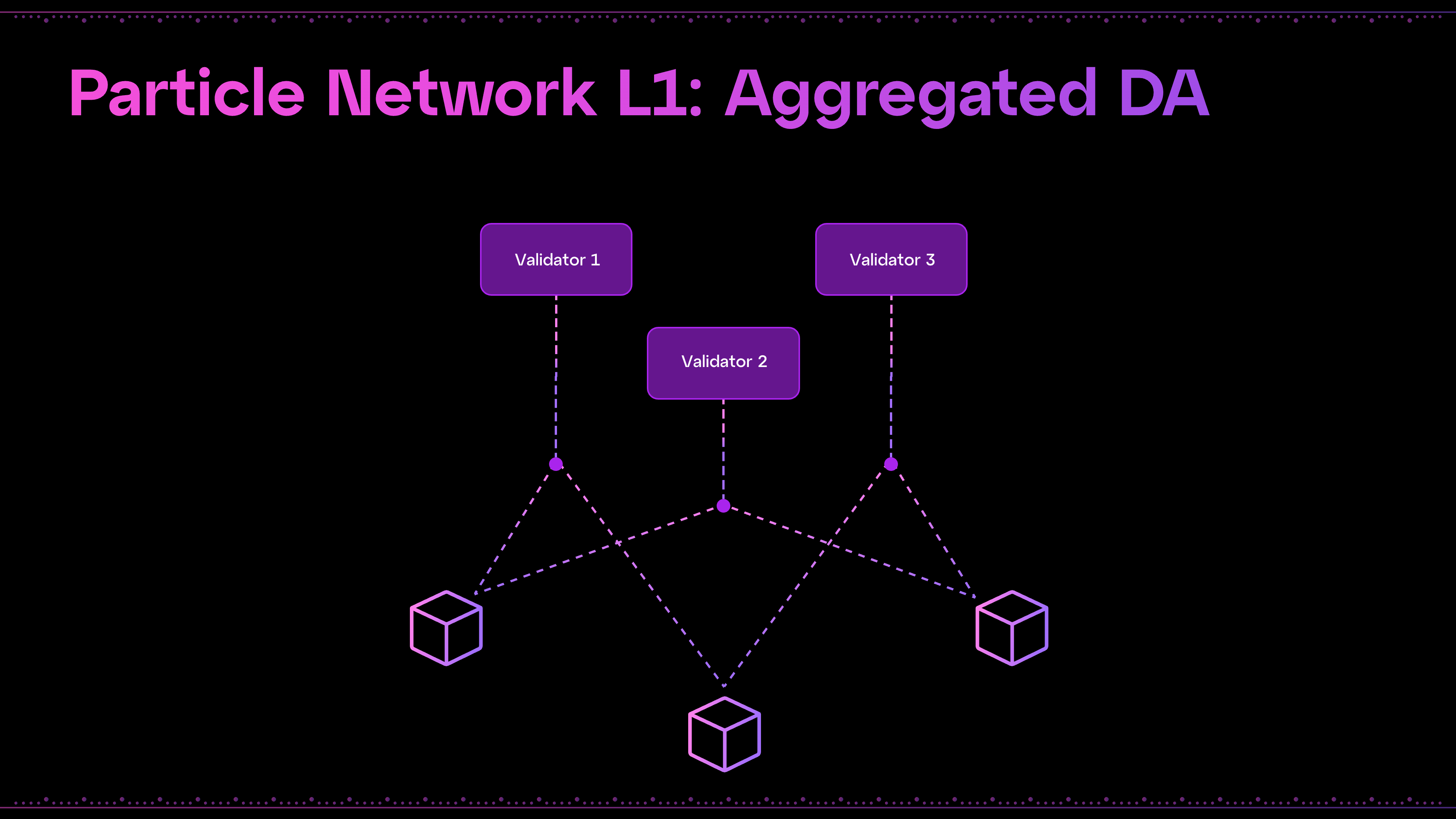
Due to the intensive task of coordinating cross-chain transactions across the entire blockchain ecosystem and simultaneously maintaining state across every Universal Account, Particle aims to maximize security and stability to build a truly robust blockchain. In the context of DA, this is achieved through the aggregation of multiple providers. These providers are:
* Celestia
* Avail
* NEAR DA
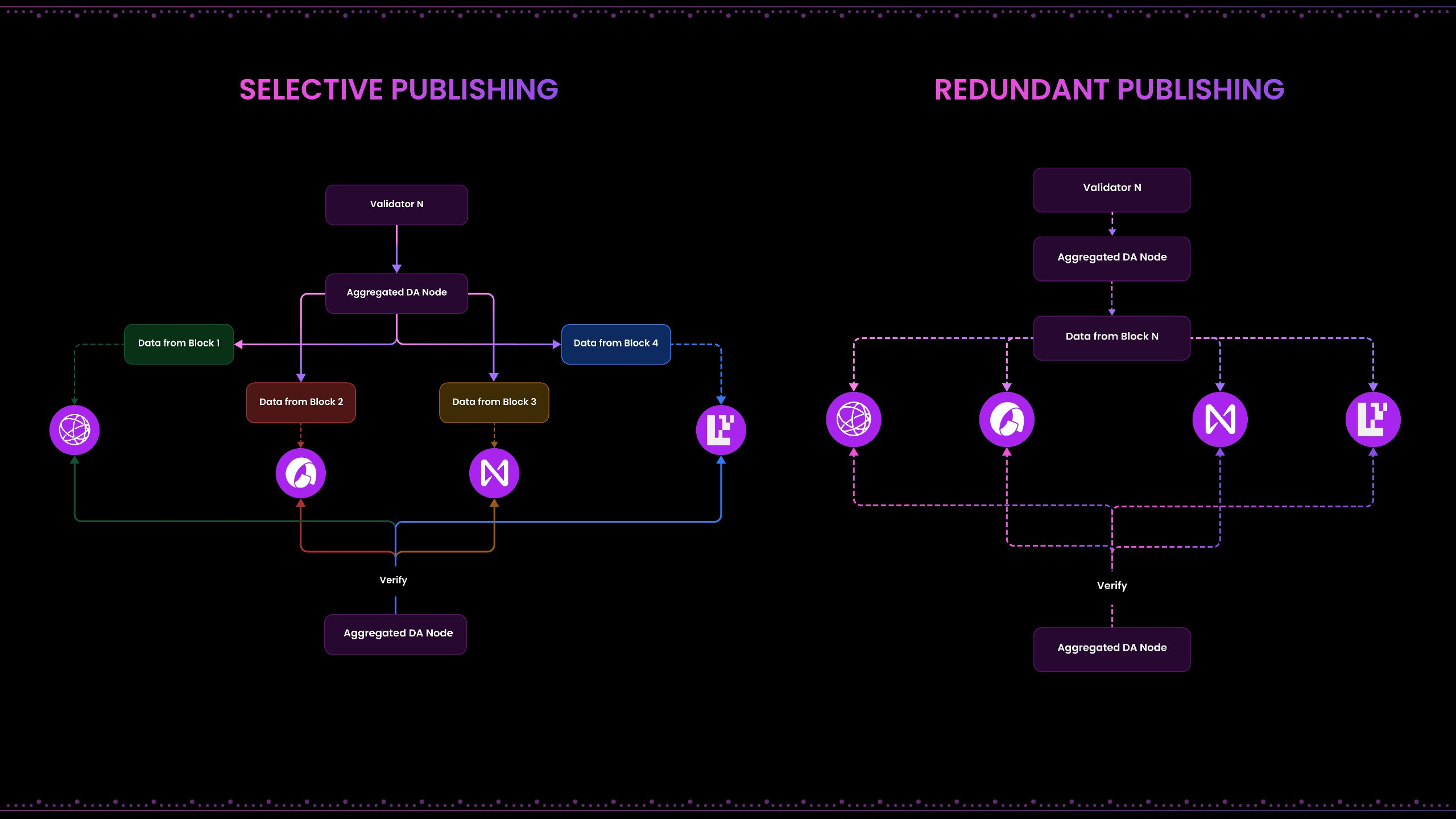
With each DA solution bringing unique benefits and performance priorities, leveraging only one would fail to meet the requirement of maximal security and stability. Therefore, Particle Network leverages random deterministic redundancy for each block, posting data between different DA layers accordingly. This model significantly enhances availability and stability through increased redundancy, as well as decentralization.
# Modular L1 Nodes
Users are able to support the Particle Chain's decentralization and security by running a node. "Modular Node" is a collective term for various types of nodes in the Particle Chain each serving different roles. \
\
Particle Network's modular design requires five types of Modular Nodes:
1. **Validator:** Responsible for validating transactions, settling the execution status of external UserOps, voting to generate blocks, and participating in the verification of fraud proofs submitted by Watchtower nodes.
2. **Relayer:** Acts as a message hub, monitoring and synchronizing the execution status of external chain UserOps and synchronizing Universal Account changes.
3. **Bundler:** Responsible for the specific execution of UserOps on external chains.
4. **DA Aggregator:** Integrates and encapsulates various DA networks such as Celestia, Avail, Near DA, and EigenDA, providing upper layers with a unified data publishing and verification interface.
5. **Watchtower:** Monitors the work of other nodes, ensuring node liveness, and provides execution proofs and possible fraud proofs for each block generated per epoch.
### Operating Conditions
The Particle Chain is an open and permissionless Layer-1, where any node operator can freely participate as long as they meet certain conditions.
The network will gradually open up, with more information to be provided later.
# Roadmap
Universal Accounts connect developers and users from all chains, creating a borderless multi-chain ecosystem.
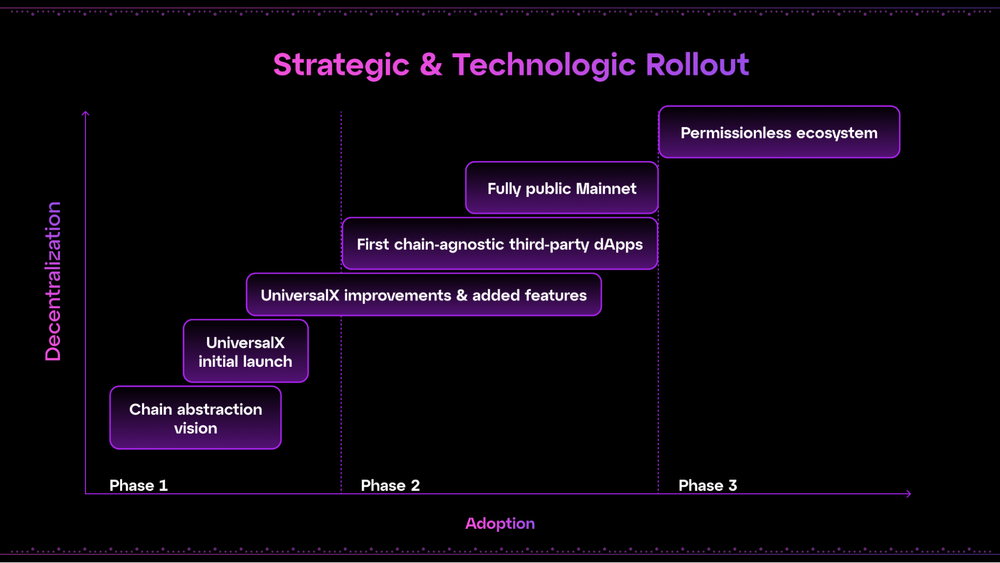
To foster Web3’s growth through the adoption of chain abstraction, Particle Network will also gradually develop and incubate high-quality applications. This process will be divided into three phases:
1. **Permissioned Ecosystem (Q1, 25):** Currently, the Particle Network team is building core, high-quality applications leveraging Universal Accounts. UniversalX has already been launched as the first chain-agnostic Mainnet application, enabling onchain trading with combined balances from every chain. In the future, and to continue fostering its ecosystem, Particle will launch two more chain-abstracted applications covering foundational use cases.
2. **Collaborative Ecosystem (Q3, 25):** In this phase, Particle Network will collaborate with key ecosystem partners to leverage Universal Accounts—within both existing and new applications—in crucial verticals such as AI, trading, and stablecoins.
3. **Permissionless Ecosystem (Q1, 26):** In this phase, any ecosystem actor can permissionlessly integrate Universal Accounts. Public chains will be able to deploy UAs into their ecosystem to connect to Particle Network. Similarly, any application developer will be able to integrate them into their dApp—enabling their users to enjoy the best experience across any application and public chain.
# $PARTI Token
Particle Network's $PARTI token is the centerpiece of the Particle Chain and its ecosystem’s economy. It is designed to streamline users’ experience by powering Universal Gas, all the while facilitating seamless settlements on the Particle Chain as an exchange mechanism for Universal Liquidity. As a PoS network, the Particle Chain relies heavily on $PARTI, alongside L1 Nodes, to form a secure foundation for Particle Network. $PARTI also serves as the sole governance token of the network.
$PARTI's supply is fixed at 1,000,000,000 tokens, with a structured release schedule designed to foster a deflationary economy and ensure long-term token scarcity.
| **Token Ticker** | **$PARTI** |
| ---------------- | ---------------------------------------------- |
| TGE Date | March 25th, 2025 |
| Network | Multi-chain/Particle Network L1's native token |
| Total Supply | 1,000,000,000 |
### Tokenomics
$PARTI's tokenomics and distribution.
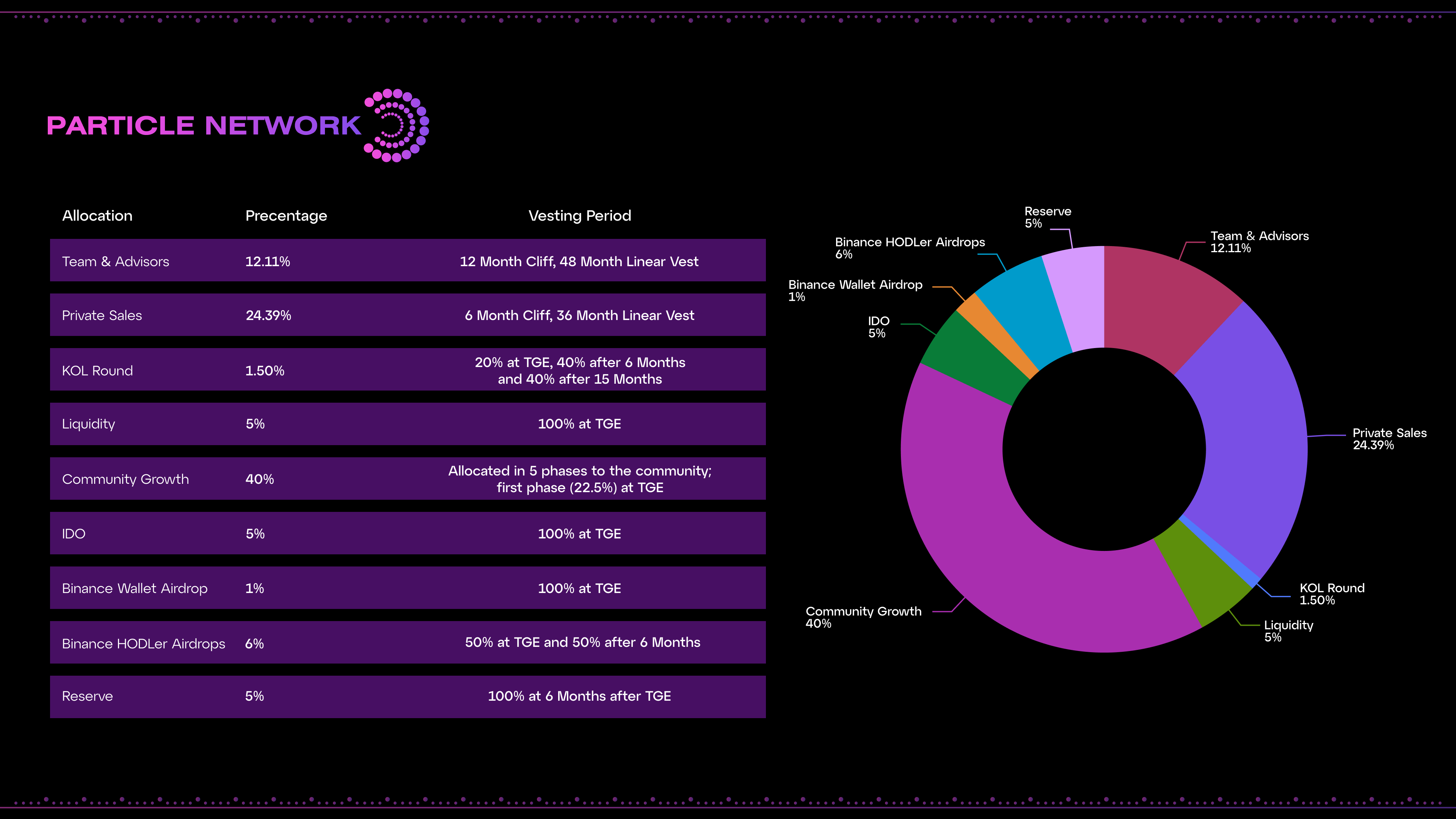
$PARTI tokens are allocated as follows:
* Team & Advisors (12.11%): Vested over multiple years for long-term project alignment.
* Private Sales (24.39%): Locked initially, with a multi-year release schedule.
* KOL Round (1.50%): Reserved for strategic influencers and partners, partially unlocking at TGE, then gradually over time.
* Liquidity (5%): Deployed at TGE to support immediate market stability and depth.
* Community Growth (40%): Distributed in multiple phases to foster user adoption and incentivize broader engagement. This includes a total of 9% for initial airdrops, with the remaining community tokens released periodically.
* IDO (5%): $PARTI’s Binance Wallet IDO.
* Binance Wallet Airdrop (1%): Allocated at TGE for targeted user onboarding via Binance Wallet.
* Binance HODLer Airdrops (6%): Distributed to long-term BNB holders, in two separate airdrops.
* Reserve (5%): Held for future strategic needs and ecosystem expansion.
# $PARTI Utility
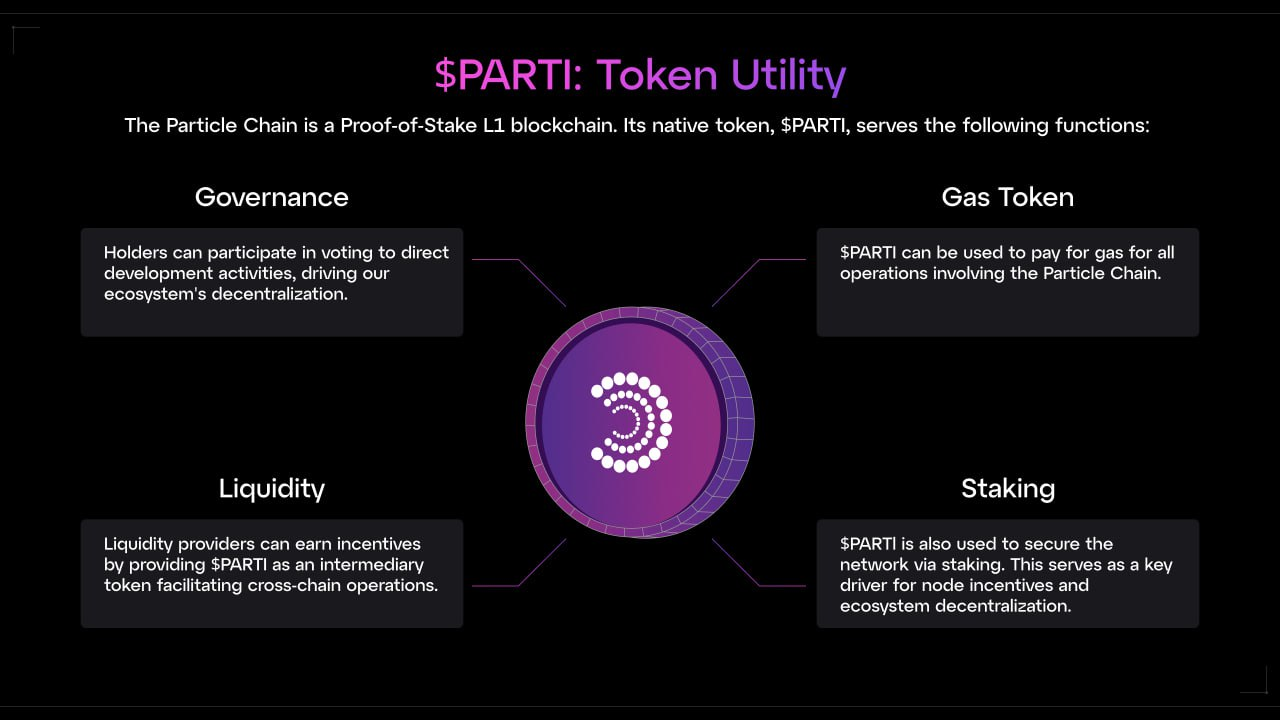
$PARTI has three main functionalities:
1. **Staking & Governance**. $PARTI holders can participate in ecosystem voting within Particle Network, contributing to and determining the direction of network development. This also achieves native decentralization at a governance level.
2. **Universal Gas Token**. $PARTI serves as Particle Network's native gas token and base gas token used by Universal Accounts. All gas fees paid by users on any chain are ultimately settled on $PARTI.
3. **Universal Liquidity Token**. $PARTI also serves as a settlement and intermediate token for Liquidity Providers (LPs) within Particle Network, participating in cross-chain atomic swaps and earning swap fees.
# Community
You can continue learning about Particle Network, engage with the community, and follow us on all of Particle's community channels:
* [Particle Network Blog](https://blog.particle.network/)
* [Discord server](https://discord.com/invite/2y44qr6CR2)
* [Twitter](https://twitter.com/ParticleNtwrk)
* [YouTube channel](https://www.youtube.com/@ParticleNtwrk)
* [LinkedIn](https://www.linkedin.com/company/particlenetwork/)
* [People's Alliance](https://ally.build/en)
* [Particle Network Docs](https://developers.particle.network/)
* [GitHub](https://github.com/Particle-Network)
# Regulatory
**MiCaR Whitepaper (Other Crypto-Asset, non ART/EMT)**
{% file src="/files/PwthQuHgViMnuU4J1cOq" %}
# Particle Network Overview
Powering Chain Abstraction Through Universal Accounts
## Particle Network
Particle Network는 Web3 전반에서 사용자와 유동성을 통합적으로 연결하는 레이어-1 블록체인입니다. 그 핵심에는 모든 체인에서 단일 계정과 통일된 잔고를 제공하는 유니버설 계정이 있습니다. 이 계정들은 Particle Network에 의해 조정되고 보안이 유지되어 Web3 생태계 전반에 걸쳐 매끄러운 경험을 보장합니다.
모든 체인을 통합함으로써, Particle은 수십억 사용자가 모든 체인에서 dApp과 원활하게 온보딩하고 상호 작용할 수 있도록 하여 대규모 채택을 위한 기반을 제공하고, Open Web 통합에 필수적인 역할을 할 것입니다.
궁극적으로 $PARTI 토큰은 Particle Network의 경제와 그 기반 인프라를 지원하게 될 것입니다.
## 번영하는 생태계
2022년에 출범한 Particle Network는 Wallet Abstraction 서비스 제공업체로 시작하여 사용자가 Web2 소셜 계정에 연결된 지갑을 생성할 수 있도록 했습니다. 이러한 지갑은 dApp에 내장된 인터페이스 내에서 네이티브로 사용할 수 있습니다. 이 제품은 이후 계정 추상화로 확대되어 Particle Network가 Web3에서 가장 큰 AA 인프라 제공업체가 되었으며, 70개 이상의 체인에 걸쳐 서비스를 제공하고 있으며 누적 UserOps 2천만, 20억 달러 이상의 자산을 보호하고 있습니다.
Particle의 솔루션은 모든 주요 BTC Layer-2 블록체인에서 사용되는 BTC Connect를 통해 비트코인 생태계를 아우릅니다. BTC Connect는 네이티브 BTC 지갑이 BTC L2에서 Particle AA Wallets의 서명자로 작동할 수 있게 합니다. 이를 통해 사용자들은 추가 제품에 의존하지 않고 Smart Accounts에서 거래를 서명하고 승인할 때 UniSat과 같은 네이티브 비트코인 지갑만 사용할 수 있습니다.
30백만 개 이상의 지갑 활성화와 7,000개 이상의 dApp 통합 후, Particle Network는 체인 추상화를 지원하기 위해 Universal Accounts를 선보이며 진화의 다음 단계를 밟고 있습니다. 이를 통해 Web3의 UX 측면에서 새로운 차원을 열고 있습니다.
유니버설X게다가, 파티클은 유니버설 계정을 활용하여 최초의 체인 불가지론 메인넷 애플리케이션.
# Why Particle Network
Solving user and liquidity fragmentation through Universal Accounts.
블록체인 생태계가 모놀리식에서 모듈러 패러다임으로 전환되면서, 우리는 구성 가능하고 애플리케이션 특화된 블록체인의 폭발적 성장을 목격했으며, 수천 개의 새로운 생태계가 탄생했습니다.\
모듈러 방식은 고성능, 확장성, 맞춤형 블록체인 아키텍처를 가능하게 하지만, 모놀리식 블록체인의 자체 포함성(self-containment)과 효율성을 희생해야 합니다. 모듈러 다중 체인 생태계에서는 블록 공간과 유연성의 한계 문제가 해소된 반면, 사용자 경험은 복잡해졌고, 유동성은 더욱 분열되었으며, 다중 체인 간 상호작용 비용은 여전히 높은 상태입니다.
개발자에게는 이러한 분열이 별도의 도전 과제를 야기합니다. 여러 체인에 걸친 사용자 분산, 높은 비용, 체인 간 전환의 번거로운 과정은 특정 생태계의 사용자를 포기하도록 강요하며, 이는 애플리케이션의 성장을 크게 제한합니다.
이러한 문제를 해결하기 위해 **Particle Network**는 **Universal Accounts**(Particle Chain 기반)를 통해 체인 추상화(chain abstraction)를 가능케 하는 독자적인 전략을 고안했습니다. Particle Network는 체인 추상화를 웹3의 초기 단계와 메인스트림 단계 사이의 전환 과정에서 누락된 핵심 요소로 이해하고 있습니다.
체인 추상화(chain abstraction)는 웹3의 제품 제공 범위와 네트워크 효과를 양적·질적으로 극적으로 확장시킬 수 있습니다. 이를 통해 프로토콜 간 경쟁이 사용자 기반이 아닌 제품 자체의 우수성을 중심으로 건강하게 이루어질 수 있게 됩니다. 더 나아가, 체인 추상화 패러다임 하에서는 프로토콜이 생태계의 나머지 부분으로부터 고립될 우려 없이 애플리케이션 특화형 블록체인(application-specific blockchain)을 보다 활발히 도입할 수 있습니다.
완전히 체인 추상화된 경험은 다음과 같습니다.
1. 앨리스는 Play-to-Earn dApp을 발견합니다. dApp은 Arbitrum에 호스팅됩니다.
2. 앨리스는 dApp을 사용하기 시작합니다. 그녀의 지갑(Polygon 네이티브)에 있는 자산은 기본 dApp 상호 작용에 사용됩니다. 브리징은 자동이며 그녀가 플레이하는 동안 원자적으로 실행됩니다.
3. 앨리스는 잠시 플레이한 후 토큰을 얻습니다. 그녀는 이를 사용하여 친구 밥의 생일을 위해 NFT를 구매합니다. 그녀가 모르는 사이에 NFT는 Optimism에 호스팅됩니다. 그녀는 이를 밥의 Universal Account로 원활하게 보낼 수 있습니다. 중요한 점은 앨리스가 전체 경험에서 단 하나의 가스 토큰만 사용했다는 것입니다.
4. 밥은 Solana에서 NFT에 대한 대출을 받고 수익금을 사용하여 밈 Bitcoin Ordinal을 구매하기로 결정합니다. 그는 몇 분 안에 몇 번의 클릭만으로 동일한 계정을 통해 이를 수행합니다.
Particle Network는 범용 결제 계층 역할을 함으로써 체인 추상화를 달성하는 시스템을 제안합니다. 이 시스템은 생태계 전반에 걸쳐 스마트 계정을 동기화하고 모든 체인에서 UX를 통합하며 사용자가 모든 체인에서 동일한 계정 주소와 잔액을 가질 수 있도록 하는 범용 계정 프로토콜을 특징으로 합니다. 범용 계정은 Particle의 범용 유동성 프로토콜을 활용하여 사용자가 크로스 체인 거래 및 스왑의 자동 실행을 통해 단일 계정으로 모든 체인에 액세스할 수 있도록 합니다. 이 공유 유동성을 통해 사용자는 모든 토큰을 사용하여 가스 비용을 지불하고 궁극적으로 Particle Chain에 결제할 수 있습니다.
체인 추상화를 가속화하기 위해 Particle Network는 또한 이 목표에 초점을 맞춘 다른 업계 참여자와 긴밀히 협력하여 표준을 수립하고 동일한 방향으로 이동하는 기존 솔루션을 구축하고자 합니다.
# Universal Accounts
Particle Network의 주력 제품인 Universal Accounts는 사용자에게 다중 체인 Web3 생태계에 대한 단일 주소, 잔액 및 상호 작용 지점을 제공하여 진정한 체인 추상화를 가능하게 합니다. 이를 통해 수동 브리징 또는 다중 체인 지갑/자산 관리가 필요 없게 됩니다.\
Universal Account를 활용하는 사용자는 모든 블록체인에서 하나의 잔액 및 계정 상태를 유지합니다. 이는 특정 블록체인에 독립적인 통합 UX를 제공합니다.\
기술적 측면에서 Universal Accounts는 Particle Chain에서 체인 전반에 배포 및 조정하는 특수 ERC-4337 Smart Account 구현입니다.\
Particle의 Universal SDK를 구현하는 프로토콜은 Particle Network의 Modular Smart Wallet-as-a-Service를 통한 소셜 로그인을 통해 검색하거나 일반적인 Web3 지갑을 연결하여 지정된 EOA 주소에 연결된 Universal Account를 할당하거나 확인합니다. 이 계정은 dApp 및 Universal Accounts를 활용하는 다른 모든 애플리케이션과 상호 작용하는 핵심 인터페이스로 사용됩니다.
## Universal Liquidity
Particle Network의 Universal Liquidity 기술은 Universal Accounts의 기반입니다. 이 기술은 거래당 원자적으로 크로스체인 거래를 조정하여 사용자의 잔액을 통합합니다.\
Universal Liquidity는 모든 체인의 잔액을 집계하는 것을 말합니다. 이는 Particle Chain에서 조정하는 원자적 크로스체인 거래와 스왑에 의해 직접 구동됩니다. Particle의 분산 메시징 네트워크는 상호 작용당 멀티체인 거래를 낙관적으로 실행하여 Particle Network의 Universal SDK를 통해 지정된 목표를 달성하기 위해 체인 간에 유동성을 원자적으로 라우팅하는 데 사용됩니다.\
예를 들어, 주어진 사용자가 Polygon에서 1 ETH 상당의 MATIC을 가지고 있지만 Optimism에서 1 ETH가 필요한 거래를 실행하는 경우 Particle Network는 의도한 상호 작용을 위해 제공된 초기 서명을 통해 크로스체인 거래를 라우팅하고 실행합니다. 이를 통해 Polygon에서 Optimism으로 가치를 빠르게 이동하여 해당 작업에 사용할 수 있으므로 모든 블록체인에 걸쳐 단일 잔액의 사용자 경험을 만들 수 있습니다.
## Universal Gas
Universal Liquidity를 통해 체인 간 잔액이 통합되어 Particle Network는 예상되는 가스 토큰의 단편화도 해결하여 응집력 있는 경험을 제공합니다.\
역사적으로 체인 간 가스 수수료 잔액을 유지하는 것은 사용자에게 상당한 마찰 지점이었습니다. Particle Network는 기본 Paymaster를 사용하여 사용자가 토큰이 유래된 체인에 관계없이 모든 토큰을 사용하여 가스 수수료를 지불할 수 있도록 합니다. 이를 통해 상호 작용이 더 쉬워지고 사용자가 생태계 전체에서 거래를 실행하는 데 필요한 자산 수가 줄어듭니다. 모든 거래는 궁극적으로 $PARTI를 통해 Particle Chain에서 결제됩니다.
# UniversalX
Particle Network에서 구축한 UniversalX는 최초의 체인 독립적인 거래 플랫폼이자, Universal Accounts를 통해 Particle의 Mainnet을 활용하는 최초의 애플리케이션입니다. 100% 비보관형이며, 사용자는 브리징 없이 모든 체인에서 모든 토큰을 거래할 수 있습니다.\
UniversalX를 사용하면 사용자는 모든 체인에 대한 통합된 잔액을 사용하여 자산을 거래, 전송 및 수신할 수 있으며, 모든 토큰으로 가스를 지불할 수 있습니다. 즉, 사용자가 토큰을 구매하려는 경우 자산이 여러 체인에 분산되어 있든 대상 토큰이 어떤 체인에 있든 상관없습니다. 구매를 클릭하면 UniversalX가 나머지를 처리합니다.
## 주요 기능
UniversalX는 체인 추상화 속성 또는 내장된 거래 기능을 위해 사용할 수 있습니다. 사용자는 다음을 수행할 수 있습니다.\
다양한 지원되는 EVM 체인 및 Solana에서 토큰을 입금합니다.\
토큰을 사용하여 이러한 모든 체인에서 통합된 잔액으로 거래합니다.\
지연 시간 없이 모든 토큰의 가격, 온체인 및 정성적 데이터를 확인합니다.\
모든 체인에서 자산을 직접 보내고 받습니다.\
모든 체인에서 모든 토큰으로 가스 비용을 지불합니다.\
직불 카드 또는 신용 카드, Apple Pay 및 기타 통합을 통해 현금을 사용하여 수천 개의 토큰, 심지어 미메코인을 구매합니다.\
초고속 속도와 확인 시간으로 거래합니다.\
완전한 MEV 보호를 누리세요.\
이 모든 것이 브리징 없이 가능합니다.\
실제로 UniversalX는 완전한 온체인 CEX와 동등한 경험을 제공합니다.
## Universal Accounts 구현
UniversalX는 Universal SDK를 통해 Universal Accounts(및 결과적으로 Particle Chain)를 최대한 활용하여 체인 추상화된 거래 경험을 제공합니다.\
애플리케이션 내에서 사용자는 구매하려는 토큰을 선택하기만 하면 됩니다. 그러면 UniversalX가 사용자가 자산을 보유한 모든 체인의 잔액을 라우팅하여 하나의 서명으로 거래를 실행하고 크로스 체인 작업을 자동화합니다.
# Technology
## The Particle Chain
Particle Chain은 Universal Accounts의 조정 엔진 역할을 하여 체인 추상화에 힘을 실어줍니다.\
Universal Account를 통해 크로스 체인 트랜잭션을 실행하면 Particle Chain은 이 트랜잭션 완료와 관련된 각 작업을 처리, 릴레이 및 관리합니다. Relayers, Bundler, Watchtowers를 포함한 복잡한 모듈형 노드 네트워크를 통해 기본 Universal Inter-Blockchain Communication Protocol과 함께 Particle Chain은 엔드투엔드 크로스 체인 작업 관리 및 실행을 처리하여 Universal Accounts에서 활용하는 Universal Liquidity를 가능하게 합니다.\
또한 Particle Chain은 모든 Universal Account 인스턴스에서 상태 패리티를 위한 중앙 저장 계층 및 진실의 원천 역할을 합니다. 새로운 Universal Account를 배포하면 해당 상태는 L1의 Master Keystore Hub를 사용하여 다른 체인에 있는 관련 인스턴스와 즉시 동기화됩니다.\
Particle Chain은 본질적으로 모듈식이므로 유효성 검사 및 데이터 가용성과 같은 주요 기능을 전문 생태계 행위자에게 아웃소싱하는 동시에 주권을 유지합니다. 또한, 원활한 호환성을 보장하고 개발자 친화성을 유지하면서 고성능 EVM 실행 환경을 제공합니다.
# Underlying Architecture
Particle Chain은 Avalanche L1입니다. 이 아키텍처는 빠른 확정성, 높은 거래 처리량, 짧은 블록 시간을 달성하는 것을 목표로 합니다. 체인 추상화를 달성하기 위해 3가지 핵심 모듈(Master Keystore Hub, Decentralized Bundler, Decentralized Messaging Network)에 의존합니다. 이는 다시 Aggregated Data Availability 및 Dual Staking 모듈에 의해 지원되어 네트워크 보안을 보장합니다.\
체인의 상위 수준 아키텍처는 아래와 같습니다.
이 아키텍처의 핵심 구성 요소는 다음과 같습니다.
## VMs compatibility
EVM, SVM, MoveVM을 통합함으로써, 앞서 언급한 모든 VM에서 체인 간의 전체 체인 상호 운용성을 간소화합니다. 통합 실행 환경은 생태적 적응 임계값을 더욱 낮추어 크로스 체인 메시징 및 DeFi와 같은 핵심 영역과의 유연한 모듈식 조합을 허용합니다.
## Universal Signatures
스마트 계약 플랫폼이 아닌 체인에서 MPC 노드를 지원하는 Universal Signatures는 기본 가상 계정에 대한 지원을 제공하여 비트코인과 같은 이기종 체인의 계정과의 상호 운용성을 구현합니다.
## Universal IBC
기존의 크로스 체인 메시징 구성 요소를 기반으로, 우리는 동시에 코스모스 생태계, EVM 체인, 솔라나, 비트코인 및 기타 체인을 연결할 수 있는 분산 메시징 네트워크로 구동되는 낙관적 크로스 체인 메시징 모듈을 추상화합니다. 이 구성 요소는 빠른 결제를 지원하며 투명한 사용자 경험에 필수적입니다.
# Core Modules
이 모듈식 L1 내에서 다음 모듈은 Universal Accounts의 설계 및 지속적인 조정을 지원합니다.\
마스터 키스토어 허브: Particle Network는 모든 네트워크에서 스마트 계약 배포 및 업데이트를 조정하는 중앙 허브 역할을 하며, 각 Universal Account 인스턴스 간에 설정을 자동으로 동기화하고 네트워크 간에 완전한 상태 패리티를 보장합니다. 계정 설정은 Particle Network에 저장되어 모든 인스턴스에서 진실의 중앙 소스로 사용됩니다. 그런 다음 Particle Chain은 이러한 설정을 준수하는 새 인스턴스를 배포하거나 이러한 설정이 변경됨에 따라 기존 인스턴스를 업데이트하기 위해 크로스 체인 메시지를 용이하게 합니다.\
분산 메시징 네트워크(DMN): Particle Network에서 Relayer 노드는 메시징 프로토콜을 사용하여 외부 체인의 UserOperations가 성공적으로 실행되었는지 모니터링한 다음 Particle Chain에서 실행 상태를 정산합니다. 외부 체인 이벤트와 상태 이벤트 정산을 모니터링하는 임무를 맡은 이 분산 Relayer 노드 네트워크를 분산 메시징 네트워크라고 합니다.
분산 번들러: ERC-4337 계정 추상화 번들러의 현재 구현은 중앙 집중화되어 검열이 가능하지만, Particle Network는 대량의 UserOperation 처리를 위해 완전히 분산화된 번들러를 설계하고 구현했습니다. 이 구현 내에서 번들러는 공개 UserOp mempool에서 거래를 가져오고, 이를 통해 Particle Network의 사용자 지정 번들러 노드에 참여하는 운영자가 처리한 후 릴레이합니다.
# Dual Staking
AggDA와 유사한 철학을 따르는 Particle Network는 높은 수준의 암호경제적 보안과 접근성을 보장하는 데 중점을 두고 합의에 접근합니다.\
지분 증명 네트워크를 부트스트래핑하는 것은 위험할 수 있으며, 종종 네트워크의 가치와 안정성에 영향을 미치는 바람직하지 않은 변동성으로 이어집니다. 이를 해결하기 위해 Particle Chain은 Tendermint를 통한 지분 증명과 Bitcoin의 기본 보안 및 검열 저항을 결합하는 이중 스테이킹 시스템을 제공합니다. Babylon의 Bitcoin 스테이킹 프로토콜이 이를 가능하게 합니다.\
이중 스테이킹은 두 개의 별개의 운영자 풀을 활용합니다. 하나는 Particle Network의 기본 토큰을 위임한 풀이고, 다른 하나는 Babylon을 통한 BTC를 위임한 풀입니다. 두 그룹 모두 유효성에 대해 개별적으로 동의해야 하며, 합의에 동등하게 참여해야 합니다.\
이러한 특성의 모델은 Bitcoin 스테이킹이 제공하는 암호경제적 보안을 통해 네트워크를 부트스트래핑하는 대신 Particle Network의 기본 토큰에 대한 압력과 보안 의존성을 크게 줄입니다.
# Aggregated DA
모듈형 블록체인 아키텍처 내에서 가장 일반적으로 아웃소싱되는 구성 요소는 데이터 가용성(DA)입니다. Particle Network도 예외는 아니지만 외부 DA 계층 구현에 고유한 접근 방식을 취합니다.\
전체 블록체인 생태계에서 크로스체인 거래를 조정하고 모든 Universal Account에서 동시에 상태를 유지 관리하는 집중적인 작업으로 인해 Particle은 진정으로 강력한 블록체인을 구축하기 위해 보안과 안정성을 극대화하는 것을 목표로 합니다. DA의 맥락에서 이는 여러 공급자의 집계를 통해 달성됩니다. 이러한 공급자는 다음과 같습니다.
* Celestia
* Avail
* NEAR DA
각 DA 솔루션은 고유한 이점과 성능 우선 순위를 제공하므로 하나만 활용하면 최대 보안 및 안정성 요구 사항을 충족하지 못합니다. 따라서 Particle Network는 각 블록에 대해 무작위 결정적 중복성을 활용하여 서로 다른 DA 계층 간에 데이터를 게시합니다. 이 모델은 중복성 증가와 분산화를 통해 가용성과 안정성을 크게 향상시킵니다.
# Modular L1 Nodes
사용자는 노드를 실행하여 Particle Chain의 분산화와 보안을 지원할 수 있습니다. "모듈러 노드"는 Particle Chain에서 각각 다른 역할을 하는 다양한 유형의 노드를 통틀어 부르는 용어입니다.
Particle Network의 모듈러 설계에는 다섯 가지 유형의 모듈러 노드가 필요합니다.\
1\. 검증자: 거래 검증, 외부 UserOps의 실행 상태 정산, 블록 생성 투표, Watchtower 노드에서 제출한 사기 증명 검증 참여를 담당합니다.\
2\. 릴레이어: 메시지 허브 역할을 하며 외부 체인 UserOps의 실행 상태를 모니터링하고 동기화하고 Universal Account 변경 사항을 동기화합니다.\
3\. 번들러: 외부 체인에서 UserOps의 특정 실행을 담당합니다.\
4\. DA 애그리게이터: Celestia, Avail, Near DA, EigenDA와 같은 다양한 DA 네트워크를 통합하고 캡슐화하여 상위 계층에 통합 데이터 게시 및 검증 인터페이스를 제공합니다.\
5\. 워치타워: 다른 노드의 작업을 모니터링하여 노드의 활성 상태를 보장하고, 각 에포크당 생성된 각 블록에 대한 실행 증명과 가능한 사기 증명을 제공합니다.
## 작동 조건
Particle Chain은 개방적이고 허가 없는 Layer-1로, 특정 조건을 충족하는 한 모든 노드 운영자가 자유롭게 참여할 수 있습니다.\
네트워크는 점진적으로 개방될 것이며, 나중에 더 많은 정보가 제공될 것입니다.
# Roadmap
Universal Accounts는 모든 체인의 개발자와 사용자를 연결하여 국경 없는 멀티체인 생태계를 만듭니다.\
체인 추상화를 채택하여 Web3의 성장을 촉진하기 위해 Particle Network는 점진적으로 고품질 애플리케이션을 개발하고 육성할 것입니다. 이 프로세스는 세 단계로 나뉩니다.\
1\. 허가형 생태계(Q1, 25): 현재 Particle Network 팀은 Universal Accounts를 활용하는 핵심적이고 고품질의 애플리케이션을 구축하고 있습니다. UniversalX는 이미 모든 체인의 결합된 잔액으로 온체인 거래를 가능하게 하는 최초의 체인 독립적인 메인넷 애플리케이션으로 출시되었습니다. 앞으로 Particle은 생태계를 계속 육성하기 위해 기본 사용 사례를 다루는 두 개의 체인 추상화 애플리케이션을 더 출시할 것입니다.\
2\. 협업형 생태계(Q3, 25): 이 단계에서 Particle Network는 주요 생태계 파트너와 협력하여 AI, 거래, 스테이블코인과 같은 중요한 수직 분야에서 기존 및 새로운 애플리케이션 모두에서 Universal Accounts를 활용할 것입니다.\
3\. 허가 없는 생태계(Q1, 26): 이 단계에서는 모든 생태계 행위자가 허가 없이 Universal Accounts를 통합할 수 있습니다. 퍼블릭 체인은 UA를 생태계에 배포하여 Particle Network에 연결할 수 있습니다. 마찬가지로 모든 애플리케이션 개발자는 이를 dApp에 통합하여 사용자가 모든 애플리케이션과 퍼블릭 체인에서 최상의 경험을 즐길 수 있도록 합니다.
# $PARTI Token
Particle Network의 $PARTI 토큰은 Particle Chain과 그 생태계 경제의 중심입니다. Universal Gas에 전원을 공급하여 사용자 경험을 간소화하고, Universal Liquidity의 교환 메커니즘으로 Particle Chain에서 원활한 결제를 용이하게 하도록 설계되었습니다. PoS 네트워크인 Particle Chain은 L1 노드와 함께 $PARTI에 크게 의존하여 Particle Network의 안전한 기반을 형성합니다. $PARTI는 또한 네트워크의 유일한 거버넌스 토큰 역할을 합니다.\
$PARTI의 공급량은 1,000,000,000개의 토큰으로 고정되어 있으며, 디플레이션 경제를 촉진하고 장기적인 토큰 희소성을 보장하도록 설계된 구조화된 릴리스 일정이 있습니다.
| **Token Ticker** | **$PARTI** |
| ---------------- | ---------------------------------------------- |
| TGE Date | March 25th, 2025 |
| Network | Multi-chain/Particle Network L1's native token |
| Total Supply | 1,000,000,000 |
### Tokenomics
$PARTI's tokenomics and distribution.
$PARTI 토큰은 다음과 같이 할당됩니다.\
1\. 팀 및 자문가(12.11%): 장기 프로젝트 정렬을 위해 여러 해에 걸쳐 부여됩니다.\
2\. 비공개 판매(24.39%): 초기에는 잠기고, 여러 해에 걸친 출시 일정이 있습니다.\
3\. KOL 라운드(1.50%): 전략적 영향력 있는 사람과 파트너를 위해 예약되어 TGE에서 부분적으로 잠금 해제한 다음 시간이 지남에 따라 점진적으로 잠금 해제됩니다.\
4\. 유동성(5%): TGE에서 배포하여 즉각적인 시장 안정성과 심도를 지원합니다.\
5\. 커뮤니티 성장(40%): 사용자 채택을 촉진하고 더 광범위한 참여를 장려하기 위해 여러 단계로 배포됩니다. 여기에는 초기 에어드롭에 대한 총 9%가 포함되며, 나머지 커뮤니티 토큰은 주기적으로 릴리스됩니다.\
6\. IDO(5%): $PARTI의 Binance Wallet IDO입니다.\
7\. Binance Wallet 에어드롭(1%): Binance Wallet을 통한 대상 사용자 온보딩을 위해 TGE에서 할당됩니다.\
8\. Binance HODLer 에어드랍(6%): 장기 BNB 보유자에게 두 번의 별도 에어드랍으로 분배.\
예비금(5%): 미래의 전략적 필요와 생태계 확장을 위해 보유.
# $PARTI Utility
$PARTI에는 세 가지 주요 기능이 있습니다.\
1\. 스테이킹 및 거버넌스. $PARTI 보유자는 Particle Network 내에서 생태계 투표에 참여하여 네트워크 개발에 기여하고 방향을 결정할 수 있습니다. 이를 통해 거버넌스 수준에서 네이티브 분산화를 달성할 수도 있습니다.\
2\. Universal Gas 토큰. $PARTI는 Particle Network의 네이티브 가스 토큰이자 Universal Accounts에서 사용하는 기본 가스 토큰 역할을 합니다. 모든 체인에서 사용자가 지불한 모든 가스 수수료는 궁극적으로 $PARTI에서 결제됩니다.\
3\. Universal Liquidity 토큰. $PARTI는 Particle Network 내 유동성 공급자(LP)를 위한 결제 및 중간 토큰 역할도 하며, 크로스 체인 원자 스왑에 참여하고 스왑 수수료를 획득합니다.
# Community
You can continue learning about Particle Network, engage with the community, and follow us on all of Particle's community channels:
* [Particle Network Blog](https://blog.particle.network/)
* [Discord server](https://discord.com/invite/2y44qr6CR2)
* [Twitter](https://twitter.com/ParticleNtwrk)
* [YouTube channel](https://www.youtube.com/@ParticleNtwrk)
* [LinkedIn](https://www.linkedin.com/company/particlenetwork/)
* [People's Alliance](https://ally.build/en)
* [Particle Network Docs](https://developers.particle.network/)
* [GitHub](https://github.com/Particle-Network)